“You can do hard things”: Education lecturer inspires learners while training towards 160km race
In Brief:
- Senior Lecturer Kate Lewis won the 82km event at the Northland 100 Ultra, setting a new wāhine ‘women’s’ course record of 9 hours 45 minutes.
- Running became an important part of Kate’s life after the death of her mother and now shapes her approach to teaching, hauora ‘wellbeing’ and perseverance.
- Her next challenge is the 160km Tarawera Ultra-Trail, as she continues to encourage her student teachers to believe they can “do hard things.”
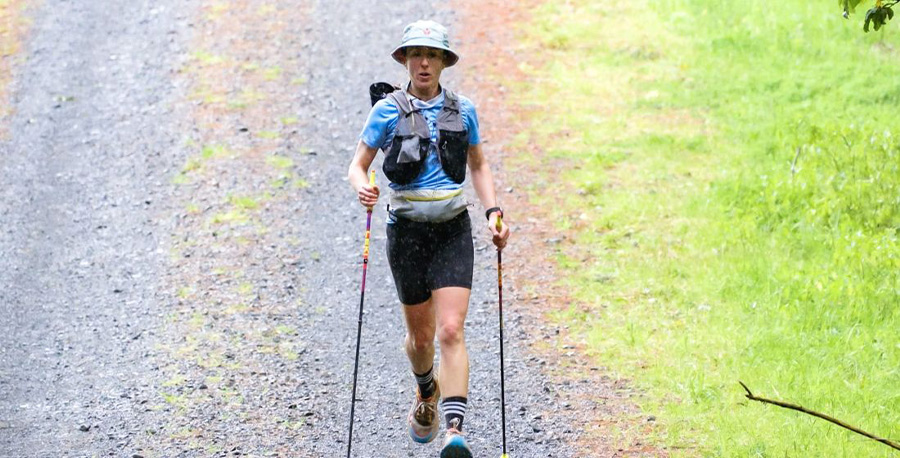
Covering 82km through the forests and trails of Northland in 9 hours and 45 minutes is the latest milestone in a running journey that has taken School of Education Ōtara Senior Lecturer Kate Lewis from her first tentative run after personal loss to the top of the podium.
Kate finished first in the event at Northland’s 100 Ultra, held in Glenbervie Forest, Whangārei, in July, setting a new wāhine course record in the process.
An ultra-marathon is any race longer than the traditional distance of 42.2km, with events ranging from 50km through to 100 miles and beyond.
For Kate, however, running is about more than competition. It has become part of her everyday life, her approach to hauora ‘wellbeing’ and the way she thinks about teaching.
A Senior Lecturer in Bachelor of Education (Primary) Pasifika programme, teaching Health and Physical Education and Mathematics, Kate regularly draws on lessons from running when training our teachers of the future.
She spoke about how her running journey began, what it takes to prepare for an ultra-marathon and why she tells her students: “You can do hard things.”
How did you get into running and then progress to ultra-marathoning?
I’ve always loved running. As a child, running around playing tig was my favourite game. I loved being fast and represented my high school and college in the 100m, 200m, and as the first leg of the relay team.
Would you believe I actually disliked long-distance running? I found it boring and would always get a stitch. I much preferred running short and fast.
Running found me, or perhaps I found it, not long after my mum, Tina passed away in 2012. Mum had terminal cancer and within nine weeks of her initial diagnosis she passed away. My mum was my everything, my best friend, and my inspiration. After losing her, I was completely lost and consumed by grief.
I hadn’t run since college, but one day I decided to put my trainers on and go for a run. It wasn’t long, and it certainly wasn’t pretty. But when I got home, I realised that it was the first time since Mum had passed that I hadn’t thought about the grief.
That moment changed everything.
Running became my way of healing. It gave me space to think, process, and move forward.
I ran my first marathon with my younger brother James in Edinburgh in 2018, just a few months before moving to Aotearoa New Zealand. Since then, I have continued challenging myself with longer and longer distances.
Aotearoa is such a beautiful country, and running has given me a wonderful way to explore it while spending time outdoors.
What does training for an 82km ultra-marathon look like?
Training for an ultra-marathon is all about consistency.
A typical week includes six runs and around 100km of running, increasing to 120–130km during peak training. I also do two strength training sessions, two cycling sessions and two swimming sessions.
It keeps me out of trouble, let’s just say that!
One of the great things is that I live in Manukau. I often commute to and from the Ōtara campus on foot or by bike. The pool is right next to campus, so there are days when I run to work, swim, teach my classes, then run home again.
Running is not something I squeeze into my life. It has become part of my daily routine and lifestyle.
How has running informed your teaching?
Running is my metaphor for life and strongly influences both my teaching and my personal philosophy.
For me, running is about putting one foot in front of the other and continuing to move forward, even when things are tough.
Learning is exactly the same.
I regularly tell my student teachers that nobody wakes up one day able to run 82 kilometres, just as nobody wakes up one day and becomes a great teacher. Progress comes through time, effort, consistency, and a willingness to keep showing up.
Having a growth mindset is incredibly important to me. Good things take time and effort. I want my student teachers to understand that challenges are opportunities for growth and that perseverance matters.
Running has also taught me the importance of having high expectations of yourself. I have high expectations for my student teachers because I know what they are capable of achieving, and I encourage them to have similarly high expectations for the learners they will work with.
Supporting hauora is another important connection between my running and teaching. In my Health and Physical Education papers, a significant focus is helping student teachers understand not only how to support the hauora of their learners, but also how to support their own.
Teaching is incredibly rewarding, but it is also demanding. I encourage my student teachers to build a kete of strategies and activities that strengthen their own whare. Running is one way I look after my wellbeing, and I encourage others to identify the practices that help keep them well too.
Running also influences my mathematics teaching. Movement supports fluency and retention in mathematics, so I love getting my students up, moving, and learning. I enjoy helping them make connections across curriculum areas and showing them how movement can be used to strengthen mathematical understanding and make learning more engaging.
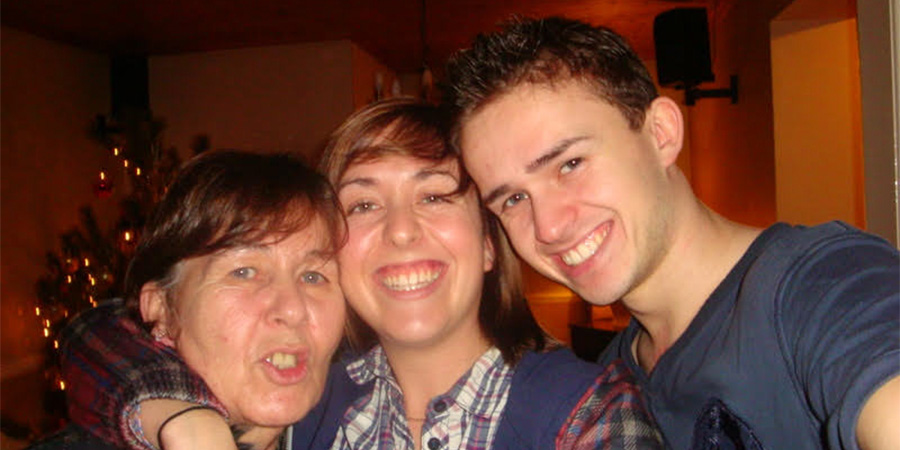
Kate with her mother, Tina and brother James.
What do you enjoy doing outside work?
Honestly? Run!
Running remains one of my favourite things to do.
I also love spending time in nature and exploring the beautiful outdoors that Aotearoa has to offer. Most of my outdoor adventures are shared with Joey, my trusty dog and adventure companion, who is rarely far from my side.
My whānau are incredibly important to me, particularly my little brother James. I still call him my little brother, even though he’s now 38 years old. He is my best friend.
I also enjoy group runs with friends and investing in my own learning and research. I am currently researching ways to support self-efficacy in mathematics for student teachers and am beginning to explore the impact of school gardens on the hauora of tamariki as my next research venture.
What’s the next challenge?
My next big goal is the Tarawera Ultra-Trail in Rotorua, where I hope to complete my first 160km ultra-marathon. It’s a distance that both excites and scares me, but that’s often where the best growth happens.
One of the mantras I live by, both as a runner and as an educator, is that with time and effort, you can achieve amazing things.
I often tell my student teachers, “You can do hard things.” Whether it’s running 160 kilometres, completing a teaching qualification, standing in front of a class for the first time, or supporting a learner through a challenge, growth comes from leaning into the difficult moments rather than avoiding them.
One of the greatest lessons ultra-running has taught me is that while it may look like an individual sport, it is actually very much a team sport. There is no way I could achieve these goals without the incredible people around me. My friends, whānau, colleagues, running buddies, my strength coach and running coach, and the wider running community all play an important role in supporting me to succeed.
The older I get, the more I realise that relationships and community are everything. A whakataukī that resonates deeply with me is:
He tāngata, he tāngata, he tāngata.
It is the people, it is the people, it is the people.
Whether I’m teaching, researching, or running through the forests of Aotearoa, it always comes back to people. The connections we build, the support we give one another, and the communities we belong to are what make it possible to achieve things we never thought possible.


