Waikato students bring their own cultural flavours to win national culinary title
In Brief:
- Waikato Diocesan School for Girls students returned after being finalists in 2025 to win this year’s National Secondary Schools Culinary Challenge at School of Hospitality, Ōtara.
- The competition brings together secondary students and industry in a tertiary environment, giving emerging culinary talent the chance to test their skills in a professional environment.
- Hosted at Ōtara Campus since 2015, NSSCC reflects our provider’s focus on excellence, industry partnerships and creating pathways into hospitality careers.
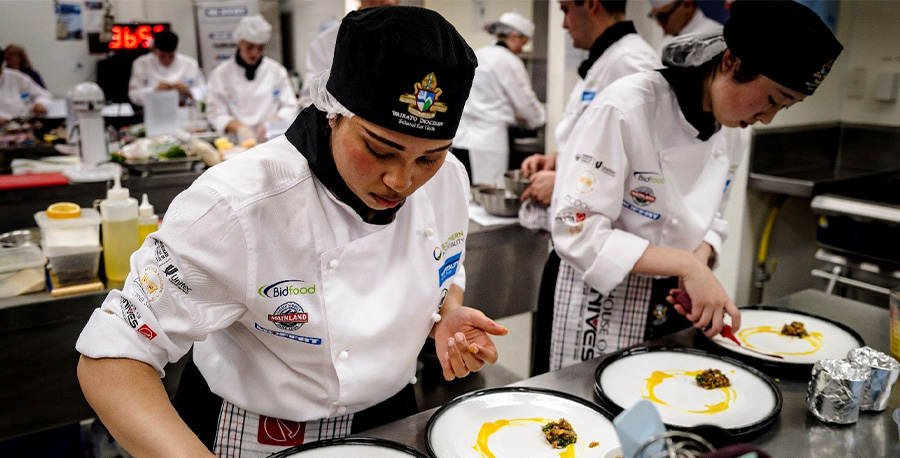
New Zealand’s top secondary school culinary talent was tested at Ōtara Campus last week in the grand final of the National Secondary Schools Culinary Challenge (NSSCC).
Hosted by MIT and Unitec’s School of Hospitality, Tourism and Service Industries, the competition brought eight regional winning teams from across the country into a live professional kitchen environment, where their skills, creativity and ability to perform under pressure was assessed by chefs, educators and hospitality industry representatives.
This year, it was Year 13 Waikato Diocesan School for Girls students Tanesha Jeyakumar and Jasper Chen who won the national title, also taking out Best Entrée.
“I guess [we were] a little bit shocked because we thought a lot of the other teams were actually really strong this year,” Jasper says.
Tanesha also says the quality of their competition had left them unsure how the result would go.
“They were so good. Everyone’s dishes looked so nice. The desserts looked so elegant.
“We were like, ‘Oh my gosh, we have such good competition. We don’t know what’s going to happen.’
“And then when we realised we won, it was just incredible.”
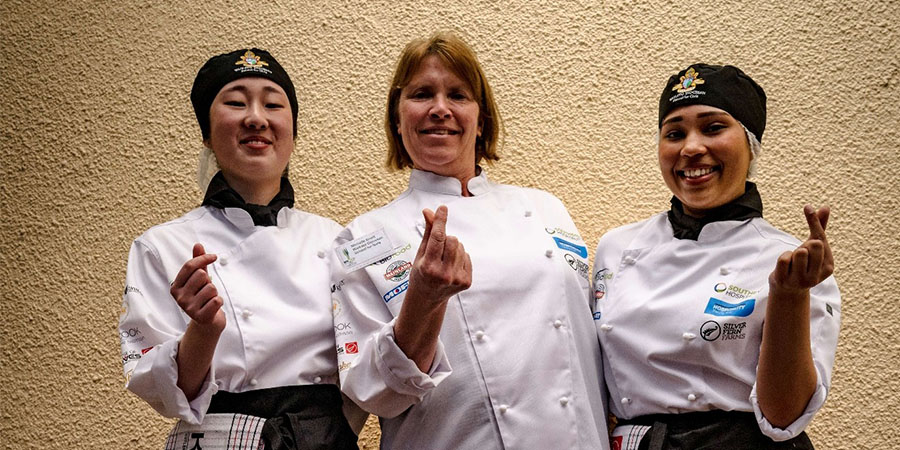
Waikato Diocesan School for Girls students Jasper Chen (L), teacher, Michelle Knott (M), and student Tanesha Jeyakumar (R)
Coming back stronger
For Tanesha, the win completed a journey that started almost immediately after last year’s national final.
“When we came last year, it wasn’t the best that we could do. So, I was like, ‘I can’t end this with a loss. We have to win this time.’”
Tanesha and Jasper began thinking about the next competition before the new school year had even started.
“I think that if I know that I can do something, I’m going to try and do it,” she says.
“We set up a Canva, we put all of our ideas. And then we met up at her [Jasper’s] house. We made just some random stuff with random mystery box ingredients to test, just to see what we actually already know how to make.”
From there, the pair continued experimenting.
One of the biggest changes from the previous year was deciding to bring more of themselves into their dishes.
Their winning entrée was beef medallions spiced with Sri Lankan black curry, accompanied by Pad Kra Pao, roasted chestnut and enoki mushrooms, a ginger-infused cream cheese pakoda, coconut sodhi and a plum tamarind sauce.
“We started off with Sri Lankan beef curry, but then we ended up like, ‘Oh, we have to showcase this cut,’ so we ended up using the same spices on the rub,” Tanesha says.
Jasper brought other elements into the dish, including enoki, sesame and the beginnings of a Chinese-inspired plum sauce.
“The sauce recipe was actually my mother’s,” Jasper says.
Teacher Michelle Knott says the determination to return and improve was there from the moment last year’s competition ended.
“It’s been a journey since the very day that we left after the awards evening last year,” Ms Knott says.
“It’s been that energy that they’ve brought and maintained all the way through.”
This time, Michelle says, a big part of the process was allowing the students to lead where the dishes went and also bring elements of themselves to the dishes.
“They’ve brought their strong friendships, their families, their community into every part of it.”
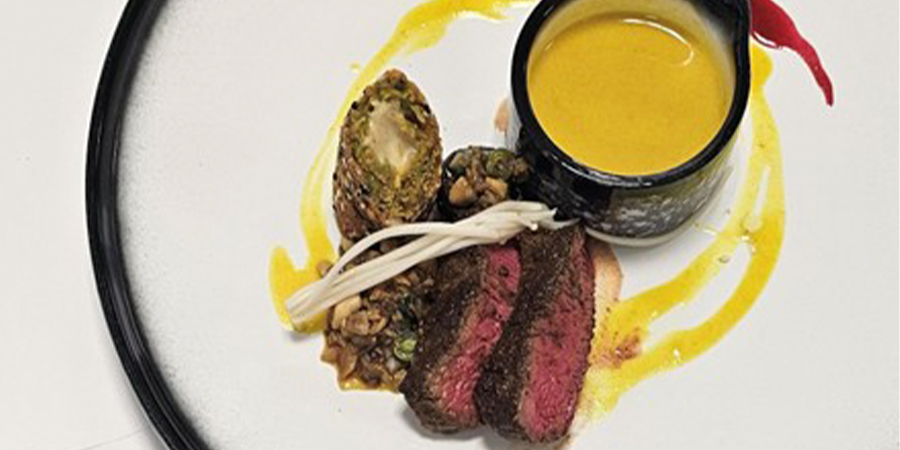
Winning Entrée dish, Beef Medallions spiced with Sri Lankan black curry
Learning to perform under pressure
For Tanesha, what distinguishes NSSCC from an ordinary cooking competition is the breadth of what students are expected to demonstrate.
“You can’t really find something like this often,” she says.
“It’s so unique to actually have a criterion, actually be judged by professional chefs. It’s not like a normal competition where just the food is judged, they judge everything that we do.”
She says the pressure develops skills that reach well beyond the kitchen.
“You learn how to do things within a timeframe, you learn how to multitask, you learn how to communicate.
“You just learn how to do everything. And obviously that can be applied anywhere in life.”
Jasper says competitors also learn how to keep refining what they create.
“There’s also just a lot of development that you learn as well, like how to turn things from something maybe quite basic into something that’s actually really good.
“And that’s not just food, it’s like anything.”
That standard was evident to MIT and Unitec graduate and competition judge Billy Cosgrave.
Billy, who studied cookery at School of Hospitality in 2016 before going on to work across different parts of the hospitality sector, returned this year for his fourth time as a NSSCC judge.
“It gets better every year,” Billy says.
“Everyone was off by maybe a point or something. That’s how close it was. Just really amazing stuff coming out of these schools.”
He has also seen schools place greater emphasis on hospitality during his time judging the competition.
“Definitely talking to the teachers, they’ve upped the seriousness of hospitality in their schools. It shows in the competition.”
That increasing focus comes as the place of applied and industry-connected learning within secondary education is also changing nationally.
The Government has recently approved Hospitality Food and Beverage as one of nine new industry-led subjects being developed for Years 12 and 13, aimed at strengthening pathways between secondary school, further study, training and employment.
Industry helping create the platform
Industry support is a significant part of making these opportunities possible for students.
Lactalis has supported the competition for the past three years, with Rob Hulse, Key Account Manager saying the partnership began from conversations about how NSSCC could continue to develop.
“Each year it grows in sophistication, each year you can create new opportunities for people, and as the industry grows, we want to see this keep pace and grow as well,” Rob says.
Increasing the standard of the competition matters because constant improvement is also part of the industry students eventually enter.
“Hospitality is driven by innovation, it’s driven by a pursuit of newness, it’s driven by a pursuit of better,” he says.
“So it’s perfectly natural, if your heart is in hospitality, that you’re going to want to see your competition grow and improve each year.
Industry involvement in NSSCC extends beyond sponsorship.
This year’s judging panel brought together expertise from across the culinary, food service and education sectors, including Adrian Brett-Chinnery, Tina Wei from Silver Fern Farms, Kelda Skelton from Culinary Collective, Brett McGregor from Compass, Royce Bold from Rescued Kitchen, Jean Wan and Geoff Scott from AUT, Jamie Johnston from ServiceIQ, and Sam Linstrom from The French Café.
For MIT and Unitec, bringing that combination of students, teachers and industry into the School of Hospitality is an important part of helping young people see where those skills can take them.
Craig Lucas, Head of School and Principal Lecturer, School of Hospitality, Tourism and Service Industries, says our institute’s long association with NSSCC reflects a commitment to both excellence and creating visible pathways into the sector.
“Competitions like NSSCC give young people the opportunity to experience what excellence looks like in a professional environment.
“They bring schools, tertiary education and industry together, and give students the chance to test themselves, build connections and see how the skills they are developing can lead into further study and a career in hospitality.”
List of winners below:
1st & Best Entrēe
Waikato/Bay of Plenty
School: Waikato Diocesan School for Girls
Students: Tanesha Jeyakumar, Jasper Chen
Teacher: Michelle Knott
2nd
South/East/West Auckland
School: Pakuranga College
Students: Dylan Meynell, Jayden du Preez
Teacher: Sanober Alwar
3rd
Hawkes Bay/Poverty Bay/Gisborne
School: Karamu High School
Students: Brodie Russell, Maaki Wairau
Teacher: Hannah Horrocks
Best Dessert
School: St Oran’s College
Students: Emma Robinson & Millicent Tait
Teacher: Jess Patel
Best Knife Skills
Miringa Bryers – Spotswood College


