
About the Lab
The AIoT Impact Lab at Unitec Institute of Technology is a research and innovation hub focused on using Artificial Intelligence (AI) and the Internet of Things (IoT) to solve real-world challenges.
The lab brings together researchers, students, industry partners, and community stakeholders to design and develop practical AIoT solutions that support sustainability, innovation, and digital transformation. Our work aligns with the United Nations Sustainable Development Goals (SDGs) and focuses on creating meaningful impact in New Zealand and beyond.
Through collaborative research, industry partnerships, hands-on projects, and student engagement, the AIoT Impact Lab provides a platform for developing smart, connected, and data-driven technologies. By integrating AI, IoT, sensors, automation, cloud platforms, and intelligent decision-making systems, the lab aims to foster technological advancement, economic growth, and sustainable development.
Mission and Objectives
The AIoT Impact Lab is driven by a mission to use Artificial Intelligence (AI) and the Internet of Things (IoT) to support sustainable development, accelerate technological innovation, and prepare the future workforce for a rapidly evolving digital world. Our work focuses on developing practical, intelligent, and connected solutions to real-world challenges across climate adaptation, smart agriculture, environmental monitoring, business sustainability, and smart systems.
Our Key Objectives
- Research and Development. Conduct innovative research on AIoT applications that support sustainable and intelligent systems, including climate adaptation, smart agriculture, real-time environmental monitoring, automation, and data-driven decision-making.
- Collaboration and Partnerships. Build strong partnerships with industry, government agencies, NGOs, research institutions, and community stakeholders to promote the adoption of AIoT solutions and create opportunities for commercialisation and real-world impact.
- Education and Training. Deliver workshops, hackathons, seminars, mentoring, and hands-on learning opportunities to help students, researchers, and professionals develop skills in AI, IoT, data analytics, cloud technologies, and intelligent connected systems.
- Industry Integration. Provide students and researchers with opportunities to work on real-world projects, internships, prototypes, and capstone initiatives that connect academic learning with industry needs and technological advancement.
Through these objectives, the AIoT Impact Lab aims to contribute to Aotearoa New Zealand’s transition toward a sustainable, innovative, and technologically advanced future.
Notable Projects/Current Research
The AIoT Impact Lab conducts applied research that brings together Artificial Intelligence, Internet of Things, cloud computing, 5G connectivity, computer vision, machine learning, sensors, and autonomous systems to address real-world challenges. Our current projects focus on practical AIoT solutions for AgriTech, smart monitoring, healthcare, sustainability, and industry collaboration.
Cloud-Based Autonomous AgriTech Vehicle for New Zealand
The lab is developing a cloud-based autonomous AgriTech vehicle designed for New Zealand’s agricultural environment. This project explores how autonomous systems, AI, cloud infrastructure, 5G connectivity, sensors, and smart data processing can support more efficient crop monitoring and decision-making.
The vehicle is being designed to provide a cost-effective, scalable alternative to traditional approaches by using cloud-based processing rather than relying solely on expensive onboard computing. The project is particularly focused on applications such as crop disease detection, orchard monitoring, pest detection, fruit ripeness assessment, and smart agricultural automation. The proposal highlights the use of AWS cloud infrastructure and One NZ 5G connectivity as key enablers for real-time autonomous operation and remote data processing.
This project is closely integrated with the lab’s AI disease detection platform. Together, these two research streams combine autonomous data collection with AI-based analysis to support future commercialisation opportunities in AgriTech, especially for grape and apple disease detection.
Research focus: Autonomous systems, AgriTech, 5G, cloud computing, IoT sensors, smart farming, crop monitoring, commercialisation.
AI Platform for Real-Time Disease Detection in Grape and Apple Crops
A major current project of the AIoT Impact Lab is developing an AI platform for real-time disease detection and classification in grape and apple crops. This project focuses on using machine learning and computer vision to detect plant diseases from images and videos collected in agricultural environments.
The project has made strong progress in developing the leaf disease prediction system. The research team has designed and trained nine machine learning models to detect eight classes of apple diseases, along with one healthy-leaf class. The system uses image pre-processing and transformation techniques to improve model performance and generalisation.
To support practical use, the team has also developed a local web application using JavaScript and FastAPI. The platform can process both images and videos of apple leaves, identify disease classes, and visualise affected areas using bounding boxes. It can also compare model performance and select the most accurate prediction for a given input.
The next stage connects the disease-detection platform to data collected by the autonomous AgriTech vehicle. Sensor readings, camera images, and IoT device inputs will be processed in the AWS cloud, enabling AI models to detect diseases in real time and support the vehicle’s automated decision-making.
Research focus: Computer vision, machine learning, plant disease detection, AI platform development, smart agriculture, and real-time analysis.
Multimodal AI for Early Alzheimer’s Disease Detection
The lab is also developing health-focused AI research through a proposed project on multimodal AI for early detection of Alzheimer’s disease. This project aims to combine structural neuroimaging and voice biomarkers to improve early detection of cognitive decline.
The research proposes a multimodal AI framework that integrates MRI-based brain imaging features with voice-derived features to distinguish among the following stages of cognitive decline: cognitively normal, early mild cognitive impairment, mild cognitive impairment, late mild cognitive impairment, and Alzheimer’s disease.
The project includes three main research aims: developing unimodal baseline models using MRI/PET and voice recordings, building an integrated multimodal model, and evaluating reinforcement-learning-based adaptive attention strategies to improve early-stage diagnostic precision.
The proposed model uses a transformer-based cross-modal attention architecture to combine imaging and voice embeddings, with an exploratory reinforcement learning component to help prioritise diagnostically relevant features.
Research focus: AI in healthcare, Alzheimer’s disease, neuroimaging, voice biomarkers, deep learning, reinforcement learning, and early diagnosis.
Fund / Grants
The AIoT Impact Lab is supported through internal research funding, commercialisation funding, industry collaboration, and in-kind technical support. These funds help the lab develop applied AIoT research in AgriTech, autonomous systems, cloud computing, 5G connectivity, crop disease detection, smart sensing, and AI-driven decision support.
Unitec Early Career Researcher Fund _ AI Disease Detection Platform
The lab received NZD $7,000 through the Unitec Early Career Researcher Fund 2025 for the project “Development of an AI Platform for Real-Time Disease Detection and Classification in Grape and Apple Crops.”
Unitec Early Career Researcher Fund – Cloud-Based Autonomous AgriTech Vehicle
The lab received NZD $2,000 through the Unitec Early Career Researcher Fund 2025 for the project “Cloud-Based Autonomous AgriTech Vehicle Designed for New Zealand.”
KiwiNet Commercialisation Fund Tier 1
The lab has secured a KiwiNet Commercialisation Fund Tier 1 grant, in collaboration with the University of Waikato, to support the commercialisation pathway for the AgriTech research programme. The team is also preparing to apply for Tier 2 funding in the next stage. The Tier 1 commercialisation documentation lists a PreSeed funding request of NZD $40,000.
One NZ – 5G In-Kind Support

The lab has received in-kind support from One NZ, including 5G services to support the AgriTech vehicle and real-time AIoT connectivity. The progress report records this support as valued at NZD $20,000+.
AWS – Cloud Research Credits
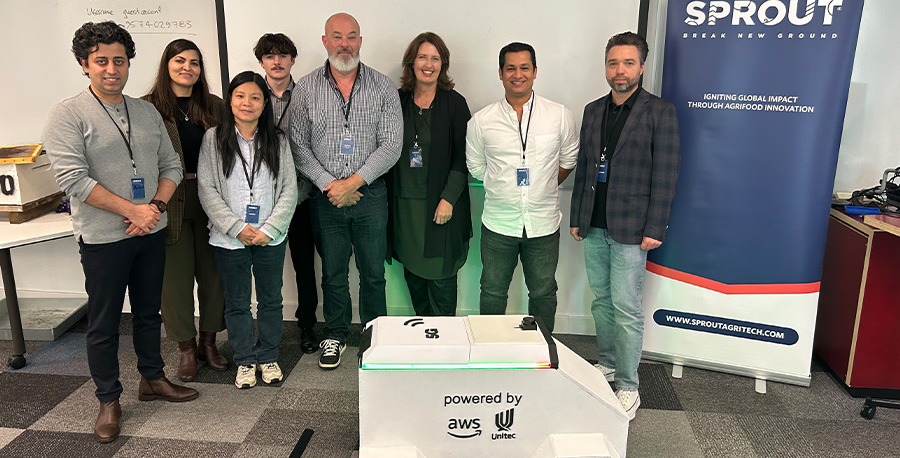
The lab has also received AWS cloud support, including research credits for AI model development, data processing, and cloud-based system integration. The progress report records AWS cloud research credits valued at NZD $8,000+.
Our Research Partners
The AIoT Impact Lab works with national and international research, industry, and technology partners to develop applied AIoT solutions with real-world impact. Our partnerships support research collaboration, student supervision, funding applications, prototype development, cloud computing, 5G connectivity, commercialisation, and international dissemination of research.
National Collaboration / Partners
- University of Auckland
- University of Waikato
- One NZ
- Auckland Radiology Group
- AI Forum New Zealand
- IoT Forum New Zealand
International Collaboration / Partners
- Sojo University, Japan
- University of the West of England (UWE Bristol)
- MISC Laboratory, University of Abdelhamid Mehri, Algeria
- Thomas Jefferson University, Philadelphia, Pennsylvania, United States
- Charles Sturt University, Bathurst, New South Wales, Australia
- Centre for AI and Data Science Innovation, James Cook University
- Technical University of Kosice, Slovakia
Research Publication
The AIoT Impact Lab produces research in artificial intelligence, machine learning, deep learning, image processing, computer vision, smart agriculture, biometrics, forensic investigation, web intelligence, and AI-enabled healthcare. The selected publications below highlight key journal articles and conference outputs connected to the lab’s research themes.
- Fonseka, H., Varastehpour, S., Shakiba, M., Golkar, E., & Tien, D. (2025). Convolutional variational auto-encoder and vision transformer hybrid approach for enhanced early Alzheimer’s detection.
Journal of Medical Imaging, 12(3), Article 034501, 1–14. doi:10.1117/1.JMI.12.3.034501 - Dave, Y., Varastehpour, S., & Shakiba, M. (2025). Predicting Forex Prices: An Evaluation of Long Short-Term Memory, XGBoost and Transformer Architectures. 5th International Conference on Advances in Electrical, Electronics and Computing Technology, 1–6.
- Lin, F., Shakiba, M., Zhang, E., & Varastehpour, S. (2025). A Recommendation System Model for Instagram Influencer Marketing Campaign. 11th International Conference on Computer Technology Applications, Vienna, Austria, 1–6.
- Singh, S. P., Shakiba, M., Varastehpour, S., & Aharari, A. (2025). Apple Leaf Disease Detection: A Comprehensive Analysis of Pre-Trained Models and Platform Development. Future Technologies Conference, Munich, Germany. doi:10.1007/978-3-032-07995-4_6
- Le, A. T., Shakiba, M., Ardekani, I., & Abdulla, W. H. (2024). Optimising plant disease classification with a hybrid convolutional neural network, recurrent neural network, and liquid time-constant network. Applied Sciences, 14(19), Article 9118. doi:10.3390/app14199118
- Le, A. T., Shakiba, M., & Ardekani, I. (2024). Tomato disease detection with lightweight recurrent and convolutional deep learning models for sustainable and smart agriculture. Frontiers in Sustainability, 5, Article 1383182, 1–6. doi:10.3389/frsus.2024.1383182
- Chishti, S. A., Ardekani, I., & Varastehpour, S. (2024).
AI-Enhanced Personality Identification of Websites.
Information, 15(10), Article 623. doi:10.3390/info15100623 - Ardekani, I., Varastehpour, S., & Sharifzadeh, H. (2023). Real-time swarming detection in honeybees: Leveraging audio signal processing and machine learning techniques. The Journal of the Acoustical Society of America, 154, 1–5. doi:10.1121/10.0023330.
- Kaur, M., Ardekani, I., Sharifzadeh, H., & Varastehpour, S. (2022). A CNN-Based Identification of Honeybees’ Infection Using Augmentation. International Conference on Electrical, Computer, Communications and Mechatronics Engineering.
- Varastehpour, S., Sharifzadeh, H., & Ardekani, I. (2021).
A Comprehensive Review of Deep Learning Algorithms.
Occasional and Discussion Paper Series, 2021(4), 1–29. Unitec ePress. - Varastehpour, S., Sharifzadeh, H., Ardekani, I., & Sarrafzadeh, A. (2020). Human Biometric Traits: A Systematic Review Focusing on Vascular Patterns. Occasional and Discussion Paper Series, 2020(3). Unitec ePress.
- Varastehpour, S., Sharifzadeh, H., Ardekani, I., & Francis, X. (2019).
Vein Pattern Visualisation and Feature Extraction Using Sparse Auto-Encoder for Forensic Purposes. 16th IEEE International Conference on Advanced Video and Signal-Based Surveillance. - Varastehpour, S., Sharifzadeh, H., Ardekani, I., Baghaei, N., & Francis, X. (2019). An Adaptive Method for Vein Recognition Enhancement Using Deep Learning. IEEE International Symposium on Signal Processing and Information Technology.
Events and News
2026 Unitec AI Hackathon
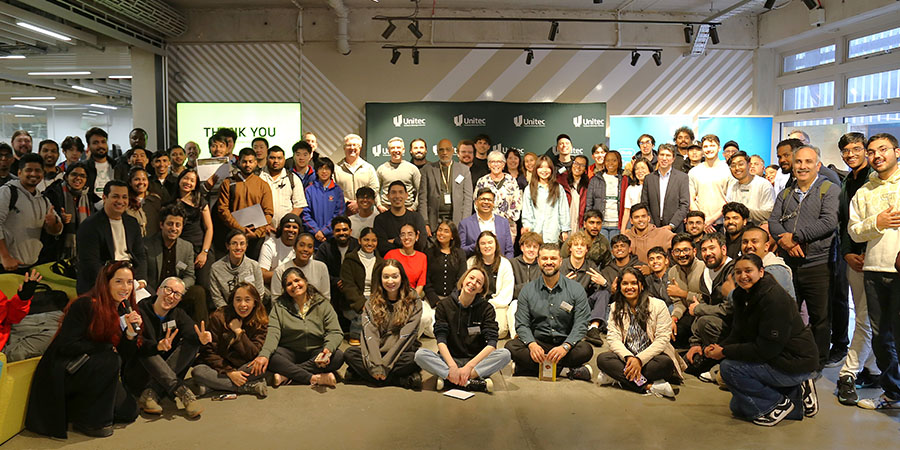
The AIoT Impact Lab is proud to support the 2026 Unitec AI Hackathon, bringing together Unitec, Manukau Institute of Technology, Seen Ventures, AI Forum New Zealand, IoT Forum New Zealand, sponsors, mentors, and volunteers. This event invites students, professionals, entrepreneurs, and innovators to collaborate to develop AI-powered solutions to real-world challenges and drive positive community impact.
People
Co-Founder, AIoT Impact Lab
- Dr Masoud Shakiba
- Dr Soheil Varastehpour
Collaborators
- Professor Ari Aharari – SOJO University, Japan
- Dr Ehsan Golkar – Thomas Jefferson University, United States
- Dr Abdollah Ah Mand – University of the West of England, UK
- Ratan Kumar – AWS Australia
- Dr Shen Lim Hin – The University of Waikato, NZ
- Dr Jamie Bell – Unitec Institute of Technology, NZ
- Dr David Tien – Charles Sturt University, Australia
- Dr Gazalnaz Sharif – James Cook University Singapore
- Saeedeh Varastehpour – Sajad University of Technology, Iran
- Dr Russel Mesbah – Unitec Institute of Technology, NZ
Research Assistantship
- Artem Tolstykh – Honorary Research Fellow
- Marzieh Aghababaie – Research Partner (KiwiNet Project)
- Harshi Fonseka – Research Assistant – ECR Internal Fund
- Raj Patel – Research Assistant – ECR Internal Fund
Contact
For research collaborations, industry partnerships, or student opportunities, please contact:

Dr Masoud Shakiba
Senior Lecturer and Co-Founder, AIoT Impact Lab
School of Computing, Electrical, and Applied Technology
Email: mshakiba@unitec.ac.nz
Phone: +64 9-892 7616
Room: 183-3016
Dr Soheil Varastehpour
Senior Lecturer and Co-Founder, AIoT Impact Lab
School of Computing, Electrical, and Applied Technology
Email: spour@unitec.ac.nz
Phone: +64 9-892 7463
Room: 183-3016


