Postgraduate research advances conservation of endangered native skinks
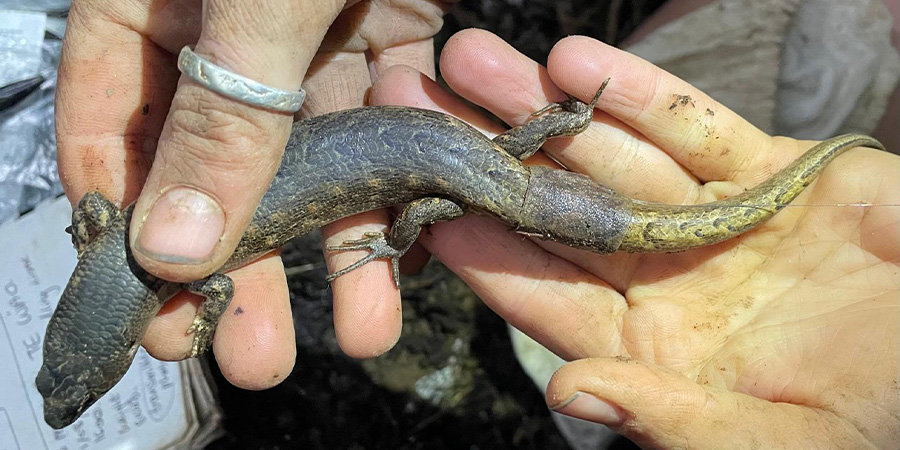
In Brief:
- Master of Applied Science ākonga ‘learners’, Meesha Anderson and Sophie Whittall, are investigating the health, behaviour and habitat use of endangered chevron skinks as part of a collaborative translocation project on Aotea Great Barrier Island.
- Working under the supervision of Associate Professor Marleen Baling, and alongside Auckland Zoo, local iwi, Department of Conservation and conservation partners, Meesha and Sophie are contributing research to support the future management of this culturally significant taonga species.
- The translocation project is being filmed for the TV show Wild Heroes, a wildlife documentary series featuring Auckland Zoo and screened on local and international networks.
The ākonga will join Assoc Prof Baling for the second translocation of captive-bred Chevron skinks, or niho taniwha, to Glenfern Sanctuary on 5 November.
Their research will help us understand how the rare reptiles adapt and establish themselves after release.
Working alongside Auckland Zoo, Ngāti Rehua-Ngātiwai ki Aotea Trust, the Department of Conservation (DOC), Glenfern Sanctuary Trust and Auckland Council, our ākonga are gaining hands-on experience in applied conservation science while producing research that could directly inform the future management of the species.
This project brings together ecological research, animal health monitoring and mātauranga Māori, recognising both the biological importance of the skinks and their cultural significance.
“Chevron skinks are only found on two islands in the world: Aotea Great Barrier Island, and Hauturu-o-toi (Little Barrier Island),” says Assoc Prof Baling, the students’ thesis supervisor.
“This translocation is the first for the species and is also culturally significant as it’s a return of these animals to their home.”
The release at Glenfern Sanctuary, an Auckland Council-managed site, will supplement an existing chevron skink population, with the research helping determine whether the translocated animals successfully establish themselves in their new environment.
Meesha and Sophie are investigating different but complementary aspects of the skinks’ health and behaviour, building an evidence base that could support future conservation decisions.
Meesha’s research focuses on the gut microbiome — the community of microorganisms living in an animal’s digestive system — and how it may relate to health and adaptation following release.
Cloacal swab samples will be collected from captive skinks before their release, as well as from resident and translocated skinks encountered during post-release monitoring.
Her research will investigate differences between captive and wild skinks and whether microbiome diversity changes over time.
“Her (Meesha) project will provide foundational information on whether the gut microbiome in NZ lizards can change over time or is set early in stage in life,” says Assoc Prof Baling.
“This has implications for species management, especially in captive environments, and for future decisions about selecting animals or populations for translocations.”
Sophie’s research, undertaken in collaboration with Jo Monks at the University of Otago, will investigate how the released skinks move through and use their new habitat.
The animals will be fitted with tiny radio-transmitters weighing less than half a gram, then track newly released and resident skinks daily for up to a month.
By recording their locations, movements, refuge sites, surrounding vegetation, temperature and humidity, Sophie will build a picture of how the animals settle into Glenfern Sanctuary.
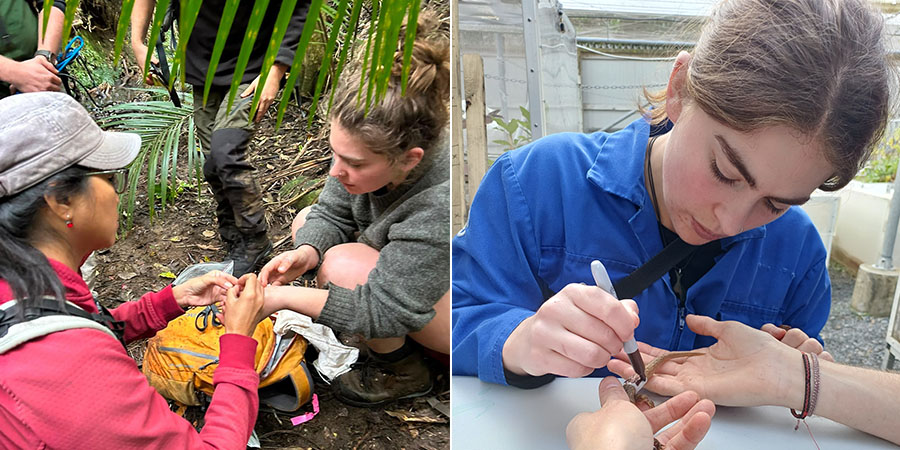
Left- Assoc Prof Marleen Baling and MAS student Sophie Whittall. Right- Attaching radio transmitters on to the niho taniwha at Auckland Zoo.
“Niho taniwha are super camouflaged and cryptic, so it’s like finding a needle in a haystack,” Sophie says.
“Even with a radio transmitter attached, it can be tricky!”
The work can take her through steep gullies, along waterways, into large debris dams and up trees following the transmitter signals.
Her research will compare the movements and habitat use of translocated and resident skinks, while examining whether seasonal differences influence their behaviour and the success of the releases.
Over time, the findings will also contribute to a catalogue of known individuals at Glenfern Sanctuary, supporting ongoing monitoring of the population, including changes in growth and body condition.
The project provides first-hand experience for our ākonga on how conservation science works in practice, bringing together technical expertise, community relationships and cultural responsibilities.
Sophie describes being involved as “an incredible privilege”, particularly given the ecological and cultural significance of returning the skinks to the island.
“You could feel the emotion and connection behind the kaupapa,” she says, reflecting on the pōwhiri for the previous niho taniwha translocation.
“I’m grateful to build on the hard work of everyone involved, while helping to gather information that can support future conservation efforts.”
Meesha says the project has highlighted the importance of collaboration between scientific organisations and mana whenua, and the value of incorporating Māori perspectives into research.
“As a Māori student, it is important to me that Māori values are included in the way I conduct science and finding different ways to consider traditional ecological knowledge when I am studying, researching or doing a project of this magnitude,” she says.
Seeing the opportunity to work alongside local iwi as integral to understanding what niho taniwha mean to the iwi and how the return of the species may affect both the community and the animals.
“This work feels important not only as we aim to add to the biological repertoire of a native species, but getting the privilege of working alongside Ngāti Rehua-Ngātiwai ki Aotea to better understand what Niho Taniwha are to them and how this return will impact iwi and the species.”
The project is also supported by Glenfern Sanctuary Trust, which provides accommodation, local knowledge, equipment and practical assistance in the field.
Assoc Prof Baling says these partnerships are essential to the project’s success, helping ensure the research addresses the conservation priorities of the organisations and communities involved.
“These types of postgraduate projects are very valuable for students to be directly involved in, as the results of their project will be directly applicable to the conservation management of the species,” Assoc Prof Baling says.
“The information that the students collect will feed back to the future monitoring and management of the species onsite, potentially modifying any future captive husbandry management and also future translocation of chevron skinks.”
Sophie says that combination of research and practical conservation is precisely what makes the experience valuable.
“I love combining research with hands-on conservation mahi, while working toward important outcomes for a species as special as niho taniwha,” she remarks.
“I’ve also made some awesome connections through the project and am gaining exactly the kind of experience I hoped to from my Master’s.”
The upcoming translocation will also be filmed by Magnetic Pictures for the TV3 show Wild Heroes, a wildlife documentary series featuring Auckland Zoo and screened on local and international networks.
Associate Professor Baling’s earlier chevron skink research was featured in the series (watch the episode here), helping make reptile conservation research more accessible to the public.
Her involvement with the species stretches back to her own master’s research at the University of Auckland in the early 2000s — bringing her work full circle, now supervising postgraduate students contributing to its conservation.


