Manaaki scholars turn personal challenges into opportunities for Pacific communities

In Brief:
- Three Manaaki scholars from Samoa, the Solomon Islands and Papua New Guinea have completed their degrees at MIT and Unitec, overcoming significant personal challenges, including the loss of close family members, with the support of their families, fellow scholars and our kaimahi ‘staff’.
- The graduates plan to take their engineering and business qualifications home to contribute to community development, government services and economic opportunities in their countries.
- The programme will welcome five new scholars in 2027, representing a 38% increase in new scholars, alongside continued vocational scholarship opportunities.
For Bachelor of Engineering Technology (Civil) student Robert Magele, his late grandfather’s encouragement carried him through his studies after moving from Samoa in 2024.
Relmah Alopitu overcame the difficulties of being in a new country to complete a Bachelor of Business (Marketing), fulfilling the hopes of her father who died shortly before leaving the Solomon Islands three years ago.
And for Papua New Guinea student Emmanuel Simon, finishing a Bachelor of Engineering Technology (Electrical) was a journey shared with his wife and two children.
Their stories brought an emotional element to a special Manaaki Scholarship completion ceremony at Te Noho Kotahitanga Marae on Wednesday 4 November.
The scholars were joined by family members, fellow recipients, kaimahi, and representatives from Ministry of Foreign Affairs and Trade (MFAT) and Education New Zealand.
Interim Manaaki Scholarships lead Advisor Byron Iosia says the ceremony not only celebrated their achievements, it reflected the purpose of the scholarship programme: empowering residents from developing countries with qualifications and skills they can take home to strengthen their communities, economies and governments.
“We wish our scholars well as they return to their home countries, where they will put their newly acquired knowledge and skills into practice and contribute to the development of their communities and countries,” Byron says.
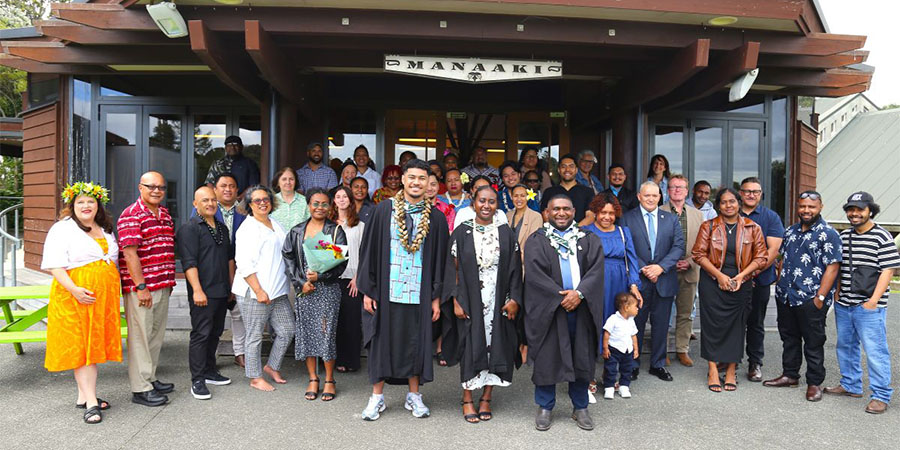
Family and friends joined kaimahi and students to celebrate the achievements of our Manaaki Scholars at Te Noho Kotahitanga Marae.
Twenty-two year-old Robert Magele, who hails from the Samoan villages of Tuasivi and Fogapoa in Savai’i, says his grandfather was a constant source of motivation, regularly calling from hospital to encourage Robert to keep studying.
“My grandfather passed away last year. The old man was the reason why I came here. He kept pushing me in my studies,” Robert says.
“I’d try to motivate him and tell him, don’t you want to see me graduate? My only regret is that he is not here to witness this milestone. I hope I made you proud Papa, I miss you very much.”
Robert discovered the scholarship through a Unitec delegation visit to Samoa. He and his brother both applied successfully, with Robert choosing civil engineering technology and his brother studying law at the University of Waikato.
Moving to New Zealand brought challenges, from adjusting to a different education system to adapting to a new lifestyle.
“My journey had its ups and downs. But thanks to my fellow scholars and the support from the staff I was able to adjust and enjoy my time,” he says.
Mr Magele now wants to return to Samoa, support his family and pursue a career in government.
For Relmah, who comes from Vella Lavella in the Western Province of the Solomon Islands, her father’s death prior to moving to New Zealand made it hard for her to adjust to life here.
“It was quite difficult for me after my father died. But through the support of my family and the team at Unitec I was able to overcome those challenges,” she says.
Living away from home, coping with homesickness and adapting to a different climate and education system tested her resilience.
“My father was a big supporter of my education. He was always someone who encouraged me to focus on school. As time went by, I realised that I had put in a lot of effort, and that’s why I was able to finish my studies.”
One of his messages has stayed with her: “If you do well, it can take you anywhere.”
With her specialisation in operations management, Relmah wants to help address logistical challenges facing businesses across the country’s many islands.
Emmanuel’s achievement was equally a family milestone. After four years of study, he acknowledged the support he received from MIT and Unitec, including regular check-ins when he struggled.
His wife, Gloria, and their two children have shared the journey. His daughter arrived in New Zealand aged three and is now almost seven, while his son was born here.
“I am the only person that is sitting in the class writing and doing exams, but the journey we did together as a family. And so they are also graduating and part of that achievement today,” Emmanuel remarks.
A former Unitec Student Council vice-president and current mentor to fellow Manaaki scholars, Emmanuel was also a finalist for the Student Engineer Leadership Award at this year’s Engineering New Zealand Awards.
His ambition is to return to Papua New Guinea and use his engineering knowledge to improve lives, particularly in rural communities.
“I’m passionate about developing communities. I just want to go back and serve, which reflects the meaning of Manaaki, to support, care for, protect and provide.”
His vision is to create a ripple effect of positive change.
“My dream is to go back home and serve one person and let that person save another so we can hopefully change our community and country.”
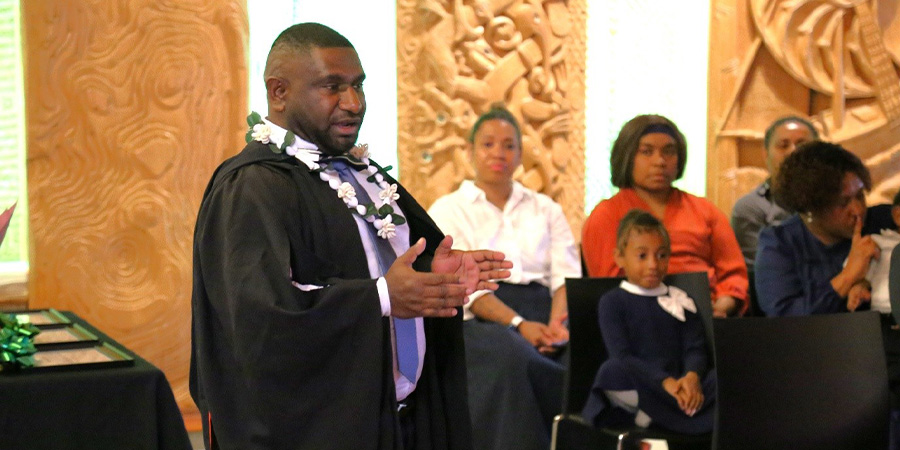
Emmanuel Simon says his family walked with him on his Manaaki Scholar journey, and they were there to celebrate with him at his completion ceremony.
The scholars’ experiences highlight the importance of the people behind the scholarship – from the families to our kaimahi who provide academic, pastoral and cultural support throughout their studies.
Taurahere Marae Lecturer Papa Hohepa Renata says the milestone represents the fulfilment of aspirations shared across generations.
“This milestone fulfils the dreams not just of our students, but their families, and the dreams of their grandparents and ancestors,” Papa Hohepa says, while acknowledging the funding organisations and the wider network supporting the scholars.
“It reminds us that the people that looked after them are an incredible village of support.”
Education New Zealand Chief Advisor Māori Ed Tuari reinforced the wider purpose of the programme, which has empowered international scholars for more than 70 years.
“You leave with more than just a qualification, you carry new perspectives, skills, knowledge and experiences, and each of you has the power to bring about positive change,” Mr Tuari says.
“Use these new tools to help your communities and countries reach the futures that they deserve.”
MFAT Senior Advisor Pacific Rob Faata highlighted the programme’s guiding whakataukī: Whakatika te parirau, kia rere ai te manu – Stretch your wings to fly out into the world.
Thanking MIT and Unitec for providing not only quality education but also the care and support that help scholars succeed.
“In addition to a world-class education, your role in hosting and uplifting our scholars in the spirit of manaakitanga, that is at the heart of this programme. So thank you very much for your efforts.”
The Manaaki programme is also expanding at MIT and Unitec, with increased funding and growing connections across the Pacific.
Byron says the institution expects a 38% increase in new Manaaki Tertiary Scholarship students in 2027.
Five new scholars from Kiribati, Tonga, Timor-Leste and Papua New Guinea will arrive in Semester One, while eight current scholars will continue their studies.
Currently, 90 per cent of MIT and Unitec’s Manaaki scholars come from the Pacific.
Recent recruitment visits to Samoa, the Solomon Islands and Tonga have helped identify local skills shortages and promote study pathways aligned with regional development needs.
Our organisation also has seven students undertaking Vocational Short Term Training Scholarships, with growing participation from Niue, Tonga and Samoa. Their study areas include mechanical engineering, electrical pre-trade, business and cybersecurity.
Close to 500 tertiary scholarships were allocated across Pacific, ASEAN and other regions in the past year, with more opportunities expected in 2027.
DCE – Learner Experience and Success Dr Simon Nash acknowledged MFAT and Education New Zealand for their ongoing investment, alongside the Schools of Civil and Electrical Engineering and Applied Business, the Scholarships team and Pacific Centre for their contribution to student success.
He also hopes to see Manaaki scholars studying at our southern campuses in Manukau, Ōtara and Tech Park in the future.


