Cook Islands Week celebration reveals unexpected family connection
In Brief
- Three Cook Islands kaimahi ‘staff’ discovered they were related while leading Cook Islands Language Week activities at the Mt Albert Campus.
- More than 320 Cook Islands learners are enrolled across MIT and Unitec, reflecting our strong connections with one of Aotearoa’s largest Pacific communities.
- Staff and students celebrated through Tivaevae workshops, traditional food, cultural displays and an online reo revitalisation webinar.
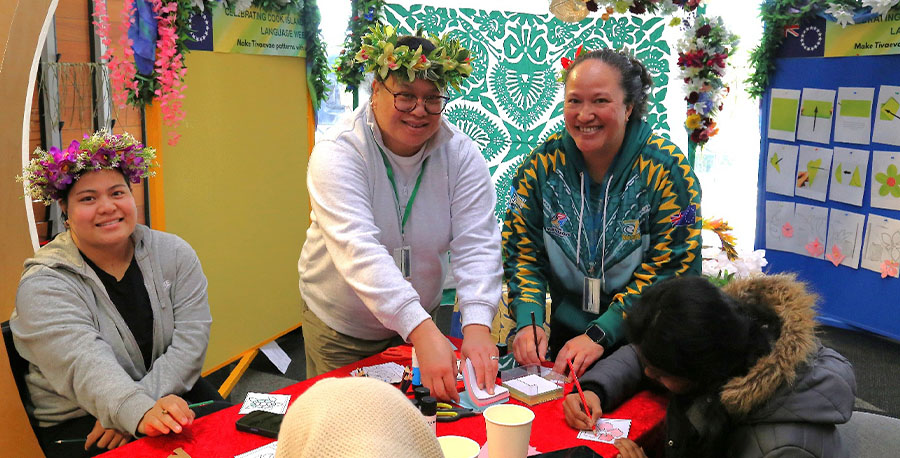
Three of our kaimahi discovered they were related while coming together to organise activities for Cook Islands Language Week at the Mt Albert Campus on Wednesday. When the call went out for Cook Islands staff to help lead this week’s celebrations, Senior Quality Administrator Tia Caffrey, Student Central Advisor Pa Tepairu Tere, and Student Events and Communications Manager Ruth Marsters all stepped forward. It wasn’t until they were hosting a Tivaevae Pattern Cutting Workshop in the Koru Pod at Te Puna that they realised they shared family ties through the island of Aitutaki. “What a coincidence this event brought us together to find out we are whānau,” laughs Pa. Ruth adds: “In true Aitutaki investigative style – harsh and fast – we’ve figured we are all Hewetts (descended) from William and Rangiuru. For me, my granny (great grandma) is their daughter Kathleen.”
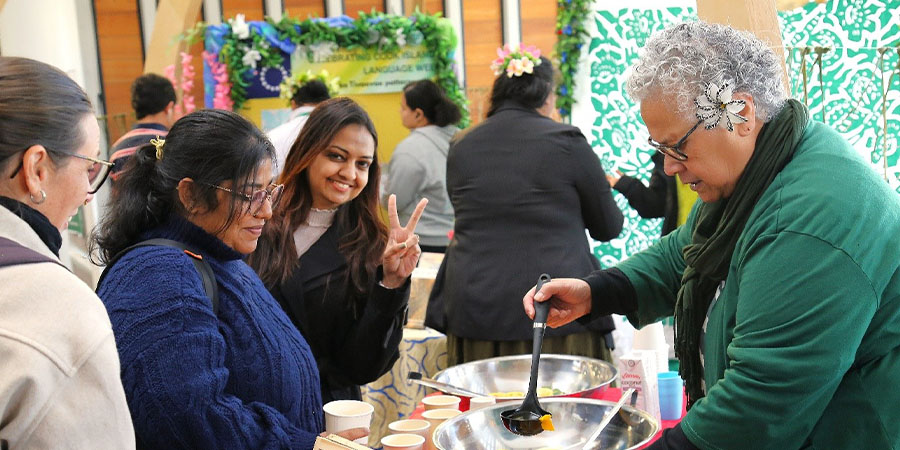
Students tasting the delicious treats at the Cook Islands Language Week display in Te Puna.
This week, our organisation is celebrating Cook Islands Language Week (‘Epetoma o te reo Māori Kūki ‘Airani’), which is also being observed across the motu as part of the annual Pacific Language Weeks programme from 2-8 August.
Aotearoa New Zealand’s historically strong connections with this Pacific Island nation can be seen on our campuses with kaimahi ‘staff’ of Cook Islands heritage working across our organisation at all levels – from lecturers and support staff to management.
According to our data, we have 326 students of Cook Islands heritage currently enrolled with us in Semester Two – 123 at our Mt Albert and Waitākere Campuses and 203 in Manukau and Ōtara.
Celebrations this week ran across the region.
The Tivaevae pattern cutting workshop drew a crowd of staff and students to our Cook Islands Language Week display during their lunch breaks. They enjoyed getting creative and having a go at designing their own Tivaevae and also taking photos with the Tivaevae backdrop wearing the traditional pare (headband). There were also library resources on Cook Islands language and culture as well some delicious traditional treats prepared by our kaimahi.
Over at our Manukau and Ōtara campuses, our Pasifika Development Office team hosted an online webinar featuring educator and community language tutor Linda Alleluiah Zoll (pictured right) where she discussed her phenomenal praxis as a cultural advocate in New Zealand known for teaching and revitalizing Reo Māori Kūki ‘Āirani (Cook Islands Māori).
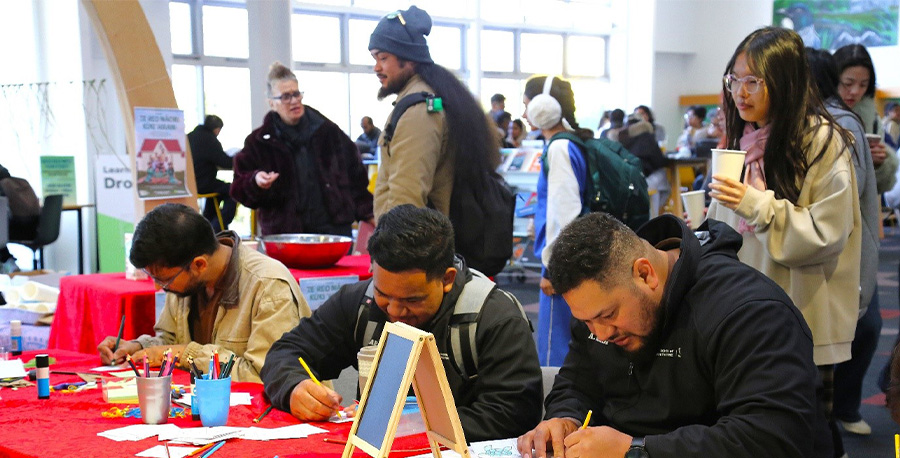
Students got creative having a go at designing Tivaevae.
Keeping language & culture alive
Acknowledging Cook Islands Māori Language Week is seen as vitally important amongst our kaimahi and learners, as their communities strive to keep their language and culture alive in the diaspora, especially amongst their rangatahi and younger generations.
This is reflected in this year’s theme for Cook Islands Māori Language Week – “Me kite koe i te tuatua i to’ou reo tupuna, e turanga rangatira tena nō’ou no te uki amuri atu” – “With our language as our foundation, we will embrace the future”.
Te Reo Māori Kūki ʻĀirani (Cook Islands Māori) is classified as an endangered language. With over 90% of the global Cook Islands population living in Aotearoa New Zealand, the majority are New Zealand-born and many do not speak the language fluently.
The last national census in 2023 saw 94,176 people listed as being of Cook Islands descent living in New Zealand.
The loss of language among the younger generations born in Aotearoa is widespread, however cultural identity remains vibrant through traditional dance, music, sport, and community events.
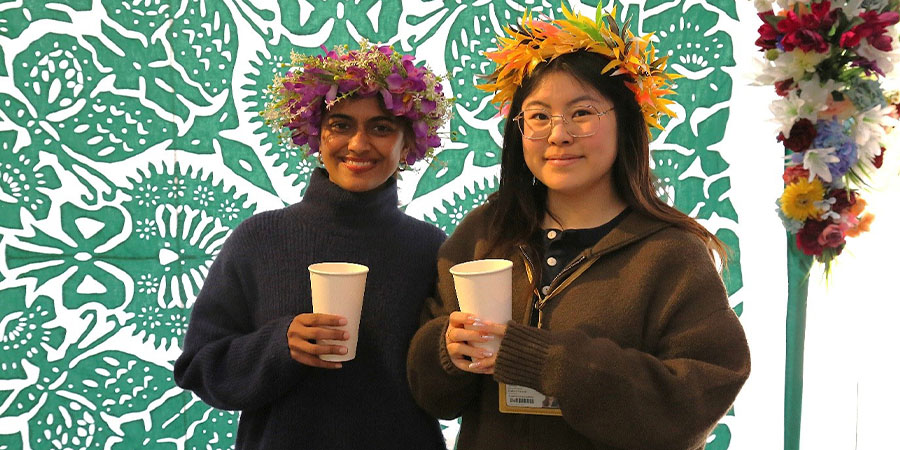
Staff and students enjoyed taking photos and wearing the Pare at the Tivaevae photo backdrop.
This was echoed by Pa who is based at our Waitākere Campus.
“It’s important we celebrate Cook Islands Language Week because it helps preserve and promote our beautiful language, especially as fewer people are speaking it today. Celebrating the language keeps it alive for future generations and strengthens our connection to our identity,” she says.
“I grew up hearing and using it at home. It was a natural part of everyday life and remains an important connection to my family, culture, and identity.
“Now that I have my own family, keeping the language alive has been more challenging. As a multicultural family with Cook Islands, Tongan, and Māori heritage, we encourage our children to embrace all sides of who they are. They have a strong appreciation for the traditions, values, and cultures that connect them to their heritage.”
Pa says she is proud to work for an organisation that embraces diversity.
“It’s always been a positive experience. I feel fortunate to work in a place where diversity is embraced, understood, and celebrated. It helps create an inclusive environment where everyone can feel comfortable being their authentic selves,” she explains.
Pa and Ruth share more about their Cook Islands connection and cultural journeys below.
‘Our language is our foundation’ – Pa Tepairu Tere – Student Central Advisor
My family comes from Aitutaki, an island famous for its breathtaking lagoon. I also have a special connection to Aitu, which is known for its rare birdlife. Every time I think about the islands, I’m reminded of the beauty of our homeland and the people who make it so special.
Although I understand Te Reo Māori Kūki ʻĀirani better than I speak it, the language has always been part of my life. Growing up, I heard and used it at home every day. It was a natural part of family life and remains an important connection to my culture, my family and my identity.
Now that I have my own family, keeping the language alive has become more challenging. We are a multicultural family with Cook Islands, Tongan and Māori heritage, so we encourage our children to embrace every part of who they are. While they don’t speak the languages fluently, they have a strong appreciation for the traditions, values and cultures that connect them to their heritage.
I keep my Cook Islands culture alive through family gatherings, attending Cook Islands church services and, of course, sharing Kūki ʻĀirani food. These moments help keep our traditions strong and create opportunities to pass them on to the next generation.
The thing I love most about Cook Islands culture is our strong sense of family and belonging. There is a warmth among our people that is hard to describe. Whether you’re family or a complete stranger, you’re often welcomed with a smile, a hug and a genuine sense of connection. If you ever visit Rarotonga or Aitutaki, you’ll experience that hospitality for yourself.
I’ve always had a positive experience bringing my Cook Islands identity into the workplace. I’m proud of my heritage and feel fortunate to work in an environment where diversity is embraced, understood and celebrated. It creates a culture where people can feel comfortable bringing their authentic selves to work.
Some of my favourite memories are our family reunions. They remind me of the strength of our family bonds and the importance of knowing where we come from. They’re a chance to learn about our ancestors, hear their stories and gain a deeper appreciation for the lives they built in the Cook Islands.
My last trip home was in 2025 and it was one I’ll never forget. It was my first visit to Aitu, where we attended a family reunion, before travelling to Aitutaki for a family unveiling and holiday. It was a significant trip for all of us, so we probably won’t return until 2027. We try to visit every second year while my dad is still fit and able to travel because those opportunities to make memories together are so precious.
If you’ve never been to the Cook Islands, my advice is simple: don’t forget your sunblock and insect repellent! Most importantly, be prepared for an amazing holiday. One of the great things is that you don’t even need to exchange your money because New Zealand dollars are accepted there.
When it comes to food, choosing a favourite is almost impossible. I love all our Cook Islands delicacies – you’re not really a Cook Islander if you don’t! But if I had to choose just one, it would be my dad’s famous banana poke.
‘Every year is another step on my reo journey’ – Ruth Marsters – Student Events & Communications Manager
Cook Islands Language Week is always a special time for me. It’s an opportunity to celebrate our connections to Aotearoa and the close relationship we share as the brothers and sisters of New Zealand Māori. Every year, it also reminds me to keep moving forward on my own journey of learning Te Reo Māori Kūki ʻĀirani.
My family connections span Palmerston, Manihiki and Aitutaki, and each island has its own story. Palmerston is synonymous with William Marsters, Manihiki is world-famous for its beautiful black pearls, and Aitutaki is simply paradise on earth.
I’m still learning Te Reo Māori Kūki ʻĀirani at my own pace. I’m grateful that my parents spoke the language at home while I was growing up, so I can understand parts of conversations – especially if I’m in trouble! That foundation has given me a lifelong connection to the language and motivates me to continue learning.
My parents migrated to New Zealand, so much of my understanding of what it means to be Cook Island Māori comes through their experiences and values. Those values have shaped who I am and continue to guide how I live each day.
If I’m honest, I wish I brought more of my Cook Islands identity into my work. But I do enjoy that it’s often one of the first personal things people learn about me. Somehow my sense of humour usually gives it away, and before long someone is asking if I know how to make Cook Islands doughnuts!
For me, one of the best things about Cook Islands culture is our humour and banter. Like many Pacific cultures, food and traditions are central to who we are, but I think there’s something really special about the way we build relationships through conversation. We laugh easily, tell stories and make people feel like they belong.
One of my most treasured memories is going to church with my nana in Rarotonga. Hearing Imene Tuki and Imene Pure today brings those memories flooding back. Those hymns connect me to my childhood, my faith and the generations before me in a way that’s difficult to put into words.
I was last in the Cook Islands in May last year and I’m hoping to return again before the end of this year. Every visit reminds me of why it’s so important to stay connected to home.
If you’ve never been to the Cook Islands, don’t just visit the main island. Take the time to explore the outer islands as well. Each one has its own identity, history and way of life, and you’ll come away with a much richer understanding of our culture.
And when it comes to food, there’s no question for me – ika mata with poke is hard to beat.
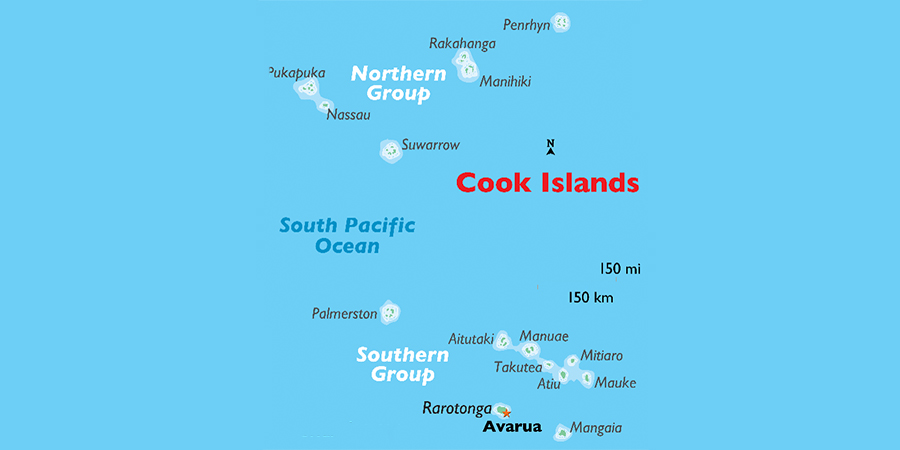
Cook Islands Maps & Facts – World Atlas
Key Facts
- Cook Islanders in New Zealand are NZ citizens with a population exceeding 94,176 (2023 Census), concentrated mostly in major urban centres like Auckland and Wellington.
- New Zealand’s Cook Islands population surged significantly during the economic and labour migrations of the 1970s. By the late 1980s, more Cook Islanders lived in New Zealand than in the Cook Islands.
- Green Party MP Teanau Tuiono is an activist, advocate, and proud Cook Islander serving in NZ’s Parliament since 2020. He hails from the island of Atiu.
- The Cook Islands consists of 15 islands, whose total land area is approximately 236.7 square kilometres (91 sq mi). The islands are divided into northern and southern groups.
-
Southern Group (These islands are mostly volcanic in origin, have larger land masses, and contain much of the population): Rarotonga, Aitutaki, Atiu, Mangaia, Mauke, Mitiaro, Manuae, Takutea
-
Northern Group (These are remote, low-lying coral atolls scattered closer to the equator): Penrhyn (Tongareva), Manihiki, Rakahanga, Pukapuka, Palmerston, Nassau, Suwarrow (Suvorov).
-
The population is about 15,040 (2021 Census), and the capital Avarua is located on the largest island Rarotonga.
-
Located in the South Pacific Ocean, it is roughly a 3 to 4-hour flight north-east from New Zealand.
-
The Cook Islands is self-governing while in free association with New Zealand. Under this arrangement, Cook Islands nationals have the right to become citizens of New Zealand and can receive New Zealand government services when residing here.
-
The country’s official name in Cook Islands Māori is Kūki ‘Āirani, a transliteration of the English name.
-
The islands are named after the English captain and explorer Captain James Cook, who visited during the 1770s.
-
The Cook Islands became a British protectorate in 1888, following a petition from Queen Makea Takau Ariki, largely because of the fear of British residents that France might occupy the islands, as it already had Tahiti.
-
The Cook Islands came under New Zealand administration in 1901. Since 1965, the islands have been self-governing in free association with New Zealand.
-
The first Monday in August is celebrated each year as Constitution Day.
-
Tourism provides the economic base that makes up approximately 67.5% of GDP.
-
On 13 July 2017, the Cook Islands established Marae Moana, making it become the world’s largest protected area by size.
Go to lunch with a friend in Cook Islands Māori
Kia ōrana! – Hello
Pe’ea koe?/Pe’ea kōrua? – How are you?/How are you both?
Meitaki ma’ata au – I am good, thank you.
Kua kaikai koe? ‘Aere mai kaikai – Have you eaten? Let’s go eat.
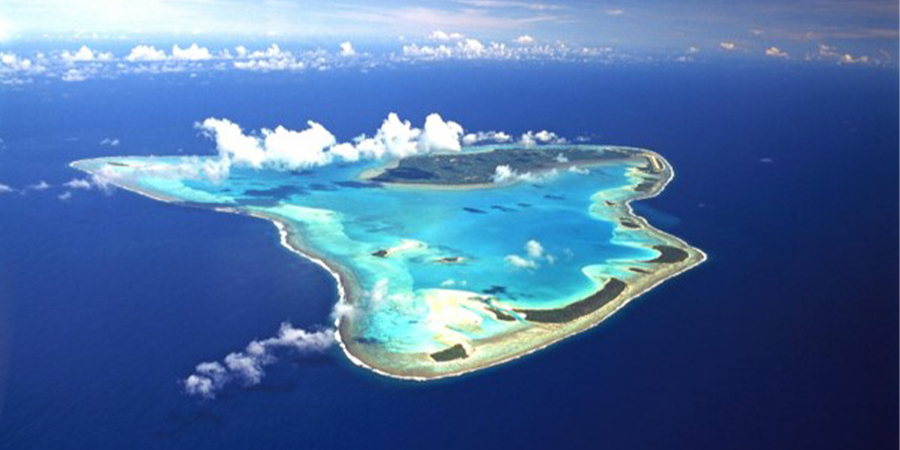
The island of Aitutaki from the air (source: travelonline.com)


