Celebrating Chinese New Year: Welcoming the Year of the Fire Horse across our Campuses
We are joining communities around Aotearoa this week to celebrate Chinese New Year — one of the most significant festivals in Chinese culture.
Marking the beginning of a new year according to the traditional lunisolar Chinese calendar, the 2026 celebrations usher in the Year of the Horse (馬, mǎ), specifically the Fire Horse.
The Horse is associated with energy, independence and optimism — qualities believed to be amplified by the Fire element, symbolising momentum, vitality and bold ambition.
Celebrations begin on Tuesday, 17 February and continue for fifteen days, culminating in the Lantern Festival on Tuesday, 3 March.
Our kaimahi and ākonga across Tāmaki are marking the occasion through a range of events and activities that honour culture, connection and community.
Campus Celebrations promote Culture and Connection
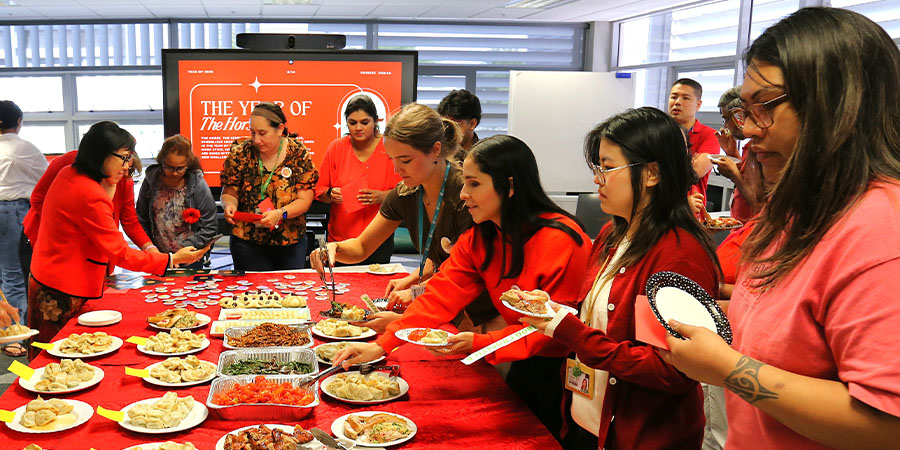
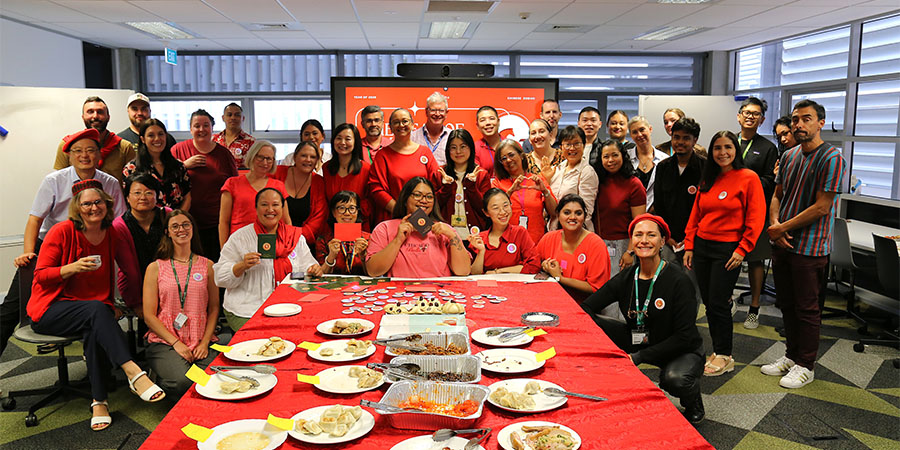
At Mt Albert campus on Monday, the Student Success teams gathered in Te Puna for a shared lunch prepared by Chinese kaimahi. The spread featured an array of traditional dishes — from dumplings, noodles and roast duck to spring rolls, rice balls and puff cakes — reflecting the generosity and hospitality that characterise the season.
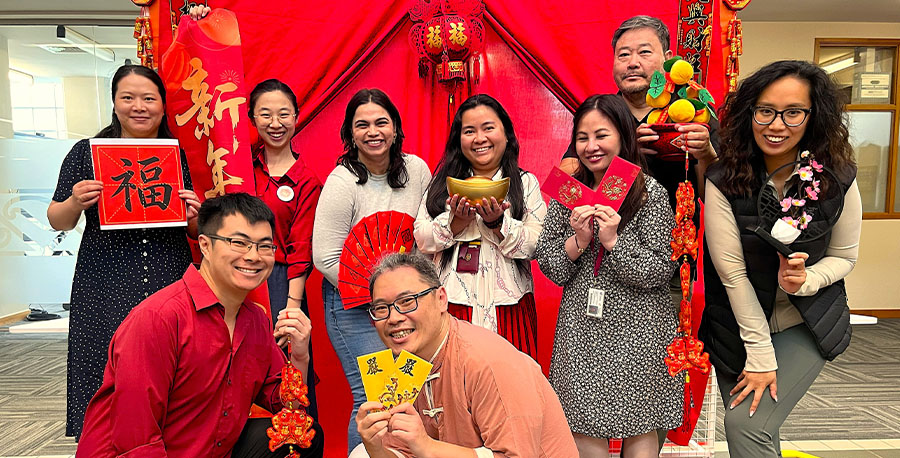
In Building 110, vibrant red decorations adorned offices and common spaces. In Chinese culture, red symbolises good fortune, joy and vitality. Staff paused to capture moments at a giant photo frame installation in the main foyer, while International Partnerships Coordinator Melody Hao offered a Chinese calligraphy demonstration, inviting colleagues to learn how to write Chinese characters.
“It was wonderful to have staff stop by to learn more about Chinese calligraphy and try writing characters themselves,” she says.
At the Ōtara Campus on Tuesday afternoon, our whānau are invited to a green tea making session plus a hand pulling noodle session at the Student Café.
The Meaning of Chinese New Year
Traditionally a time to honour deities and ancestors, Chinese New Year centres on reunion, gratitude and hope. Across China and throughout the global Chinese diaspora, families gather to share meals, exchange blessings and welcome good fortune for the year ahead. Customs vary by region, but the spirit of renewal and togetherness remains constant.
We asked members of our Chinese community at our Mt Albert and Waitākere campuses, what the festival means to them and how they plan to celebrate.
Partnerships Manager Jialu Ding, from Shaoxing in Zhejiang Province, describes the New Year as a time of reflection and fresh beginnings.
“For me, Chinese New Year is a moment to look back on the past year and set intentions for the next. I’ll be celebrating with friends and enjoying traditional dishes like Ba Bao Fan (Eight Treasures Rice), which symbolises good fortune.”
Originally from Shanxi Province, Student Central Advisor Yifei Cheng says the festival represents reunion and renewal.
“Chinese New Year has always symbolised togetherness for me — along with good food, fireworks and red envelopes. This year, we’re sharing auspicious sayings inspired by the Horse: may you achieve instant success, take the lead, and gallop toward grand ambitions.”
Operations Manager Hung Ngo, who was born in the Year of the Dog, sees the Year of the Horse as dynamic and full of opportunity.
“This is a year where effort goes further,” Hung says with a laugh. “I’ll be celebrating with a big family feast, visiting relatives, and giving red packets to children. It’s a time of generosity, connection and starting the year with joy.”
Assets Coordinator Untaka Cai, who hails from Shanghai, echoes this sense of togetherness.
“Because the celebrations last many days, I hope everyone joins us in the spirit of the season. It’s a time to celebrate, eat and connect.”
For Melody Hao, who is from Guangzhou, the Year of the Horse carries personal significance.
“My grandfather was born in the Year of the Horse, so it has always been one of my favourite zodiac signs. The horse represents resilience, energy, freedom and strength — qualities I admire and try to embody. Now that I have a child, the festival means even more. It’s about passing on culture and tradition to the next generation.”
Senior Lecturer Dr Hua Dai, originally from Henan Province, begins the year having recently completed her PhD.
“The Horse spirit has propelled me into a powerful new phase. It feels like a strong and dynamic year ahead — energised and full of possibility.”
Customer Services Team Leader Sara Wang, from Zhengzhou, sees 2026 as a year of momentum.
“It’s about positivity and embracing new opportunities with confidence. I’ll be celebrating with family and friends, sharing meals, exchanging blessings, and reflecting on gratitude and growth.”
International Student Advisor Grace Zhang says the festival remains deeply meaningful after more than 25 years in Aotearoa.
“I treasure the traditions I grew up with. I celebrate by reconnecting with family and loved ones, and by sharing this time with my wider whānau in our Student Success teams. My Chinese ancestry is an important part of who I am — it keeps me connected to my heritage while embracing the diverse cultures that enrich our community.”
As we welcome the Year of the Fire Horse, our campuses reflect the values at the heart of the festival: community, cultural pride, generosity and optimism for the future.
May this new year bring energy, progress and success to all — and may we continue to celebrate the rich diversity that strengthens our MIT and Unitec community.
Did you know?
- 628 ākonga of Chinese ethnicity are enrolled at Unitec for Semester One, 2026
- Unitec maintains strong, long-term partnerships with Chinese tertiary institutions (e.g., Shandong Jianzhu University, Shandong Polytechnic College)
- In 2025, MIT signed a new joint programme agreement in nursing with Changsha Social Work College, one of the top vocational schools in China.
- 279,039 people identify as Chinese in New Zealand, with nearly 70% residing in Auckland (2023 Census)
- Chinese New Zealanders account for 4.9% of the NZ population, and are the country’s largest Asian ethnic group.
- There are 56 ethnic groups and over 300 languages spoken across China.


