Building stronger responses to family violence through community connection
In Brief:
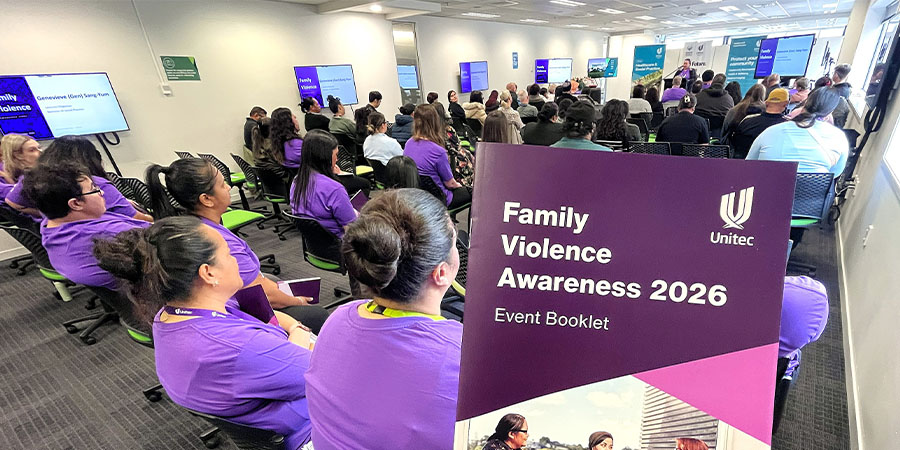
- Close to 100 people – including Social Practice ākonga and kaimahi, social practitioners and community organisations – came together at Waitākere Campus on 17 September to share knowledge and perspectives on family violence.
- Guest speakers from immigration law, disability and family violence advocacy, and child protection highlighted the complex and often hidden factors that can affect people experiencing family violence.
- The event gave future social practitioners practical insights into recognising family violence, asking the right questions, responding appropriately and connecting people with specialist support.
New Zealand has the highest rates of family violence in the OECD with Police conducting more than 100,000 investigations related to family violence each year, according to Ministry of Justice data.
Hosted by Bachelor of Social Practice ākonga taking the family violence course taught by lecturer Genevieve Sang-Yum, the Family Violence Awareness Event presented the realities faced by people experiencing family violence and professionals working at different points of the response system.
The event supports the kaupapa (purpose) of White Ribbon day, which will be observed worldwide on 25 November, and promotes respectful relationships and action to prevent men’s violence towards women.
Guest speakers brought perspectives from immigration law, disability and family/sexual violence advocacy, and child protection and family harm.
Principal Immigration Lawyer Aaron Martin highlighted how immigration status can intersect with family violence, with immigration dependency potentially becoming a tool of coercive control and influencing whether someone feels able to safely leave a relationship.
Mr Martin advised social workers, counsellors, community practitioners and ākonga to recognise immigration status as part of the wider context of family violence, rather than treating it as simply an administrative issue.
“You can make an enormous practical difference. You don’t need to determine the person’s immigration options. Ask the right questions at the right time,” he says.
“If somebody experiencing family violence asks, ‘if I leave will I be deported?’ That might sound like an immigration question. In reality, it may be one of the questions that determines whether the person believes they can leave. That’s why immigration status needs to be understood as part of the wider subject for migrants and their families.”
Petra Fowler, a social worker of more than 30 years and a Family Violence/Sexual Violence Network Educator with community organisation VisAble, brought a disability and safeguarding perspective to the event.
Her work focuses on strengthening awareness and organisational capability to prevent and respond to family and sexual violence, abuse and neglect affecting disabled people and their whānau.
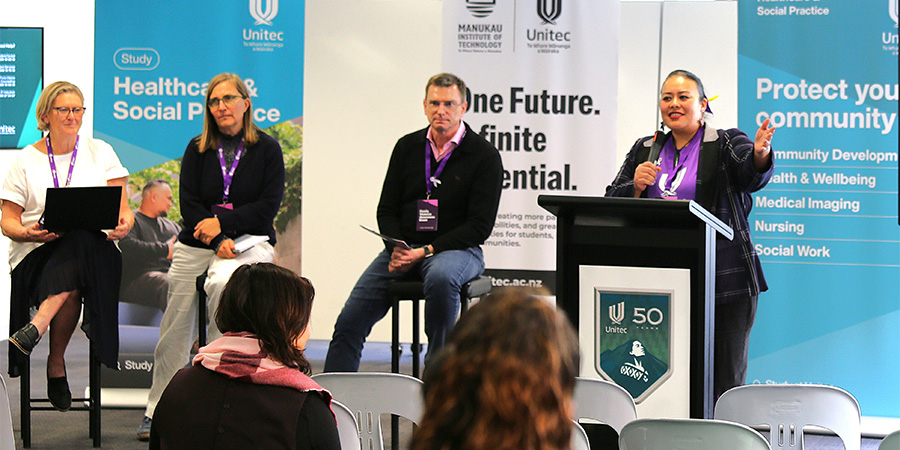
Caption: Bachelor of Social Practice lecturer Genevieve Sang-Yum (far right) introduces the three panel guests (L-R): Karen Young (Oranga Tamariki), Petra Fowler (VisAble), and Aaron Martin (NZ Immigration Law).
Karen Young, a Bachelor of Social Work alumna, who works for Oranga Tamariki as a Family Harm Specialist based in Henderson, says her advice to aspiring social practitioners and our ākonga was to be passionate about making a difference.
“The mahi that a social worker does is not easy. No two days will ever be the same for you. It takes passion, courage, patience, resilience and a real genuine interest for people because they will see through you very quickly.
“Choose a pathway that you’re really interested in and passionate about. I do this every day because I think, ‘can I make a difference’? If you are a great social worker and that’s your fit, then go out and be the best you can be in that role.”
Their presentations were followed by a Q&A, which gave students and attendees the opportunities to ask questions about the realities, challenges and responsibilities involved in responding to family violence.
The urgency behind the conversation is reflected in latest national data.
Ministry of Justice & Women’s Refuge NZ data reports that nearly half of all homicides and reported violent crimes are related to family violence with around 67% of family violence episodes going unreported.
Ministry of Justice’s 2025 NZ Crime and Victims Survey found that 256,000 family-offence incidents were recorded in 2025, up from 207,000 in 2018. While fewer adults experienced family-violence offences overall, the increase in incidents was driven in part by repeat victimisation.
The figures also point to the importance of understanding that family violence does not affect all people in the same way. The latest data shows disproportionate impacts on demographics including disabled people, Māori and LGBTQ+ adults.
For Genevieve, those statistics reinforce why family violence needs to be addressed as both a community issue and a professional capability.
“Family violence affects people from all walks of life, including students, staff, whānau, and members of our wider community. Many people either do not recognise the signs or do not know where to seek help.”
A key message from the event was that family violence is not always visible.
Genevieve identifies barriers including shame and stigma, fear of not being believed, financial dependence, concerns about children, fear of retaliation, cultural barriers and limited knowledge of available support.
Some important factors can be overlooked including the use of animals as a means of controlling victims, the needs of disabled people, and the importance of stronger collaboration between government agencies and community organisations.
Future practitioners need to be able to recognise family violence within wider circumstances rather than treating it as an isolated issue — understanding how trauma, poverty, substance misuse, social isolation and intergenerational patterns can intersect with experiences of violence.
The event provided an opportunity for students to not just learn more about the reasons for family violence, but the confidence to notice, listen, respond appropriately and connect people with specialist support.
“It highlighted the deeply layered and complex reality of those experiencing domestic violence within our communities, especially for those who are already marginalised. This reinforces the importance of having a space for knowledge sharing to build resilience and sharing resources,” says Bachelor of Social Practice student Courtney Maree.
Genevieve adds: “I hope the event prepares our students with foundational knowledge that they can carry into their future professions. Whether they work in social services, health, education, justice, or other sectors, family violence is an issue they are likely to encounter.”
Looking forward, while prevention begins with conversations — it needs to lead somewhere.
“While we may not be able to solve family violence in a single event, we can increase awareness, challenge harmful beliefs, and encourage people to seek support earlier,” Genevieve explains.
“Seeing staff and students from across our organisation, in the same room as social service agencies and community members showed me that family violence is everyone’s issue and that coming together as a community is the first step toward doing something about it.”
The Family Violence Awareness event is an example of applied education connecting learning with community need — preparing our future social practitioners to recognise family violence, understand its different forms and contexts, and play their part in creating safer relationships, whānau and communities.
Family Violence support
If you or someone you know is impacted by Family Violence, you can find resources and learn how to access support at the Are You OK website. The website has a tool to keep pages visited hidden in your browser history.
You can also find resources aimed at preventing family violence at the White Ribbon New Zealand website.


