As climate change and rising seas threaten her homeland, Tuvaluan student champions education, language and identity
In Brief:
- Tuvalu Language Week brought ākonga ‘students; kaimahi ‘staff’ and Auckland’s Tuvaluan community together to celebrate language, culture and identity on Wednesday, 30 September.
- The celebration highlighted the importance of identity and recognising the resilience of Tuvalu’s people in the face of climate change.
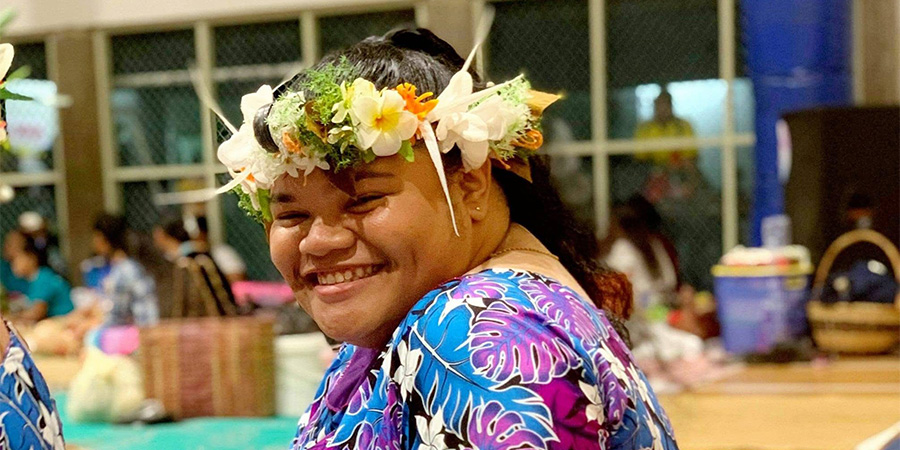
Bachelor of Social Practice ākonga Souzhay Segaawekana Eluti has seen firsthand the effects of climate change on Tuvalu’s nine islands – from coastal erosion and stronger storms to drought – understanding the uncertainty these changes create for the future of her people and places she calls home.
But Souzhay says the story of Tuvalu cannot be defined by climate change alone.
“We are not defined by our struggles, but by how we continue to come together, protect what we love, and carry our culture forward for future generations.”
That message sits at the heart of Vaiaso o te ‘Gana Tuvalu – Tuvalu Language Week, being celebrated across Aotearoa New Zealand from 27 September to 3 October, and this year’s theme: “Tuvalu, alofa ki tou fakavae, kae teugina tou iloga i tau kete fai malaga” – “Tuvalu, cherish your foundation, and carry your identity along your journey.”
The week was celebrated at Mt Albert Campus on Wednesday, 30 September with kaimahi and ākonga gathering with members of Auckland’s Tuvaluan community to celebrate their language, culture and identity.
Director – Pacific Success Doana Fatuleai acknowledged the growing population with over 6,500 Tuvaluans calling New Zealand home, according to the Stats NZ 2023 Census, with about 80% residing in Auckland —particularly out west in Henderson and Massey.
There were cultural presentations by Tuvaluan kaimahi Molia Alama and special guest, Miss Sei Tuvalu New Zealand 2026 Peleise Ian Natano, who performed a Fatele – traditional Tuvaluan dance.
The event concluded with Tuvaluan traditional food being served to guests at the Pacific Centre.
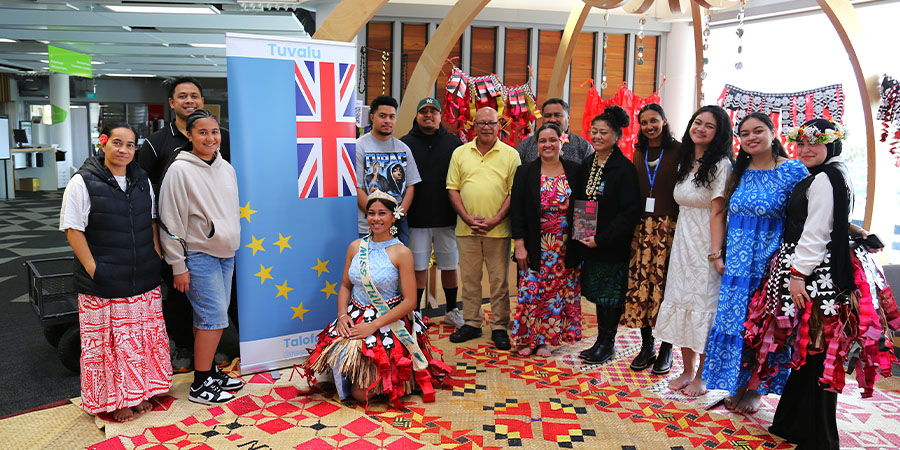
Kaimahi, ākonga and Auckland’s Tuvaluan community gathered for Tuvalu Language Week celebrations at our Mt Albert Campus on Wednesday.
This year’s Tuvalu Language Week theme resonates strongly with Souzhay’s own experience.
“No matter where life takes me, I carry Tuvalu with me,” she says.
Born in Auckland but raised in Tuvalu until she was 17, Souzhay traces her roots to Nui and Nanumea. She speaks Tuvaluan and Nui and says her language is an essential connection to her ancestors, family and home.
“For me, speaking Tuvaluan is more than communication. It is a way of honouring my ancestors and preserving a part of myself that I never want to lose. It carries the stories, values, humour, and wisdom of our people.”
Moving between Tuvalu and New Zealand has given her a personal understanding of what it means to maintain cultural connections while pursuing new opportunities.
“Cherishing my foundation means remembering where I come from, and carrying my identity means proudly sharing who I am wherever my journey takes me.”
That connection between identity, education and future aspirations is also shaping Souzhay’s education journey and career path in social practice.
Continuing her Bachelor of Social Practice studies, Souzhay hopes to use both education and lived experience to support Pacific communities, particularly Tuvaluan families and young people in Aotearoa.
“I want to be someone who empowers others, strengthens community wellbeing, and helps ensure that future generations remain connected to their culture, language, and identity,” she says.
Quick facts about Tuvalu
- 6,585 Tuvaluan people live in Aotearoa New Zealand according to the Stats NZ 2023 Census, with about 80% residing in the Auckland region—particularly in West Auckland areas like Henderson-Massey.
- Established in 2003, the Pacific Access Category immigration pathway allows up to 75 Tuvaluan citizens to settle in New Zealand each year, driven partly by rising sea levels threatening their low-lying island nation
- Tuvalu is composed of three reef islands and six atolls located northwest of Samoa in the Pacific Ocean. Tuvalu’s total land area is only 25.14 square kilometres.
- Tuvalu has a population of 10,643, according to their last census in 2022. That makes the island nation the second-least populous country in the world, behind Vatican City.
- Because it is a low-lying island nation, Tuvalu is extremely vulnerable to sea level rise due to climate change. At its highest, Tuvalu is only 4.6 metres (15 ft) above sea level. It is estimated that a sea level rise of 20–40 centimetres (7.9–15.7 inches) in the next 100 years could make Tuvalu uninhabitable.
- The Tuvalu language is closely related to other Polynesian languages like Samoan and Tokelauan but also has borrowed heavily from Samoan due to historical missionary influence. Tuvaluan has two main dialects, spoken in the northern and southern parts of the islands.
- Tuvalu was formerly known as the Ellice Islands, a name given by English hydrographer Alexander George Findlay.
- In the late 19th century, Great Britain claimed control over the Ellice Islands, designating them as within their sphere of influence.
- From 1916 to 1975, they were managed as part of the Gilbert and Ellice Islands colony.
- On 1 January 1976, the old administration was officially separated, and two separate British colonies, Kiribati and Tuvalu, were formed.
- On 1 October 1978, Tuvalu became fully independent as a sovereign state within the Commonwealth and is a constitutional monarchy with Charles III as King of Tuvalu.
- On 5 September 2000, Tuvalu became the 189th member of the United Nations.
- Due to the lack or arable soil, the country relies heavily on imports and fishing for food. The nation also derives income from its “.tv” internet domain.


