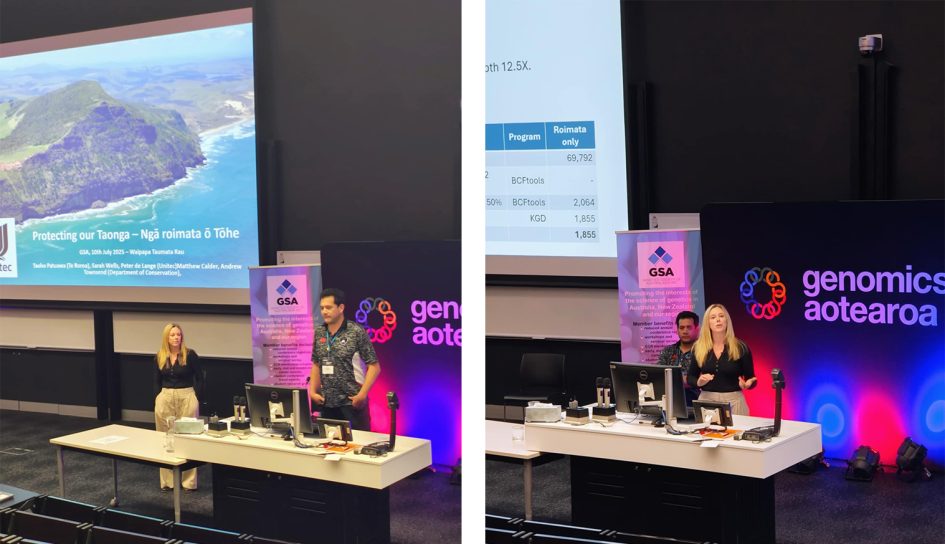
At the 2025 Genetics Society of AustralAsia (GSA) conference, held from 7–10 July at the University of Auckland, Dr Sarah Wells of the Applied Molecular Solutions research centre (AMSRC) and Te Roroa Science Advisor Taoho Patuawa delivered a joint talk highlighting their collaborative research on the conservation genomics of Ngā Roimata o Tōhe, Pimelea eremitica. Their presentation offered an example of how genomics and mātauranga Māori can be woven together to protect taonga species.
On a windswept basalt cliff at Maunganui Bluff in Northland grows a small, unassuming shrub found nowhere else in the world. Ngā roimata ō Tōhe (Pimelea eremitica), a taonga species to Te Roroa iwi, has clung to survival at a single site for decades. Today, that wild population is functionally extinct. But thanks to a handful of cuttings taken decades ago, and some careful genetic detective work, the species has a real shot at recovery.
Our latest research, a collaboration between the Applied Molecular Solutions Research Centre, Te Roroa, and the Department of Conservation, provides the first ever genomic snapshot of this critically endangered plant; and the results carry both a warning and a message of hope.
A species on the edge
Ngā roimata ō Tōhe was only formally described in 2009, and its entire known wild population is confined to two basalt outcrops on Maunganui Bluff. Habitat fragmentation, invasion by exotic grasses, and browsing by feral goats have driven a steep decline over the past 40 years. Recognising the danger, Te Roroa began taking cuttings from wild plants back in the 1990s, propagating them in their Waipoua nursery and did so again in 2018 and 2019, when a team abseiled down the cliff face to rescue plants from a second, harder-to-reach outcrop.
It was a forward-thinking move. But because detailed records weren’t kept during those early rescue efforts, nobody knew exactly what had been saved. Were the roughly 30 labelled plants now in cultivation 30 genetically distinct individuals? Or mostly clones of just a few?
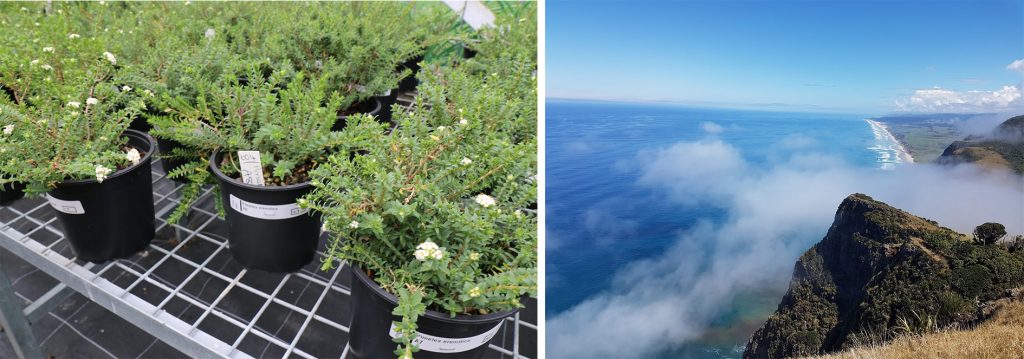
Left: Ngā Roimata o Tōhe, Pimelea eremitica, in its natural habitat on Maunganui Bluff. Right: Maringinoa, the summit of Maunganui Bluff, where ngā Roimata o Tōhe is found.
Genotyping the nursery
Using genotyping-by-sequencing, we generated close to 1,900 high-quality SNPs from every plant that could still be found in the two ex-situ collections, along with samples from related Pimelea species to check for possible hybridisation.
The results answered the outstanding questions and turned up some surprises:
- A population on the brink, and it shows in the DNA. Coalescent modelling of the population’s history revealed a sharp, recent genetic bottleneck.
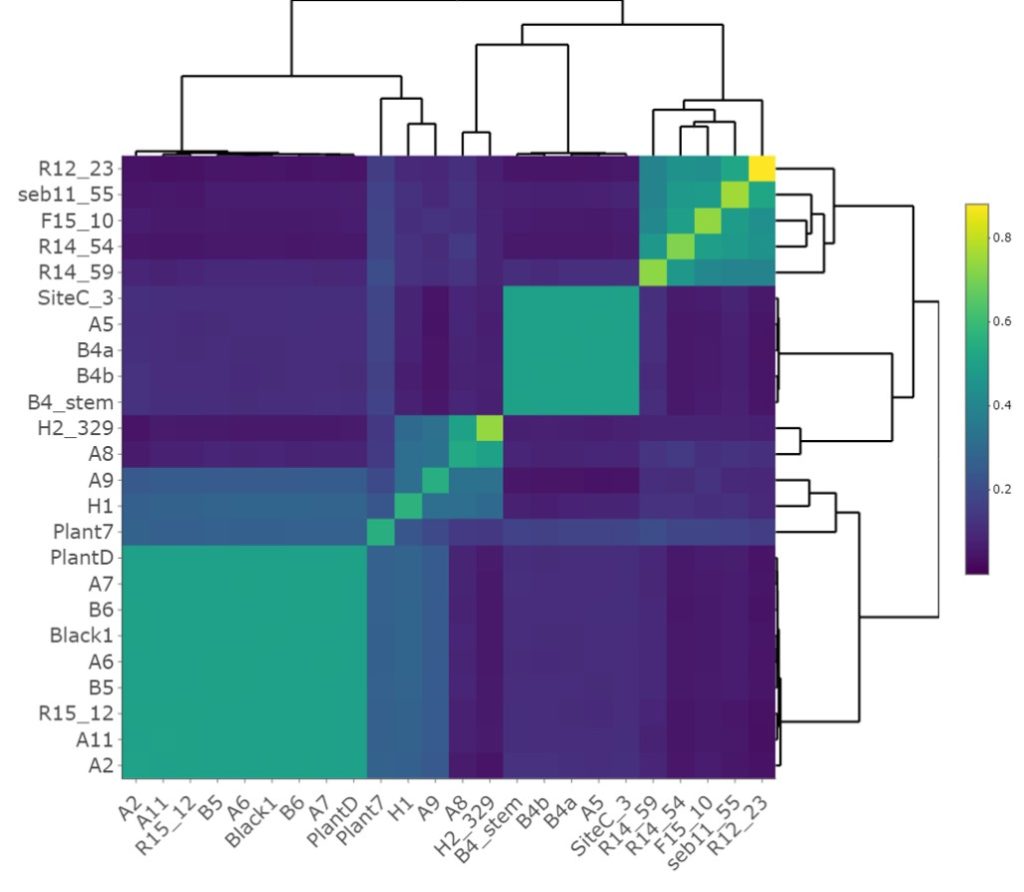
- Only twelve unique plants (genets) remain, hiding among the roughly 30 labelled cuttings. Several of the “different” plants turned out to be clones of the same individual, propagated and given separate names.
- The species is genetically distinct. Despite ongoing taxonomic debate about how many true Pimelea species exist in Aotearoa, our data confirm ngā roimata ō Tōhe forms its own coherent genetic lineage, with no evidence of hybridisation with the other species sampled.
- Time capsules of diversity. The plants collected in the 1990s possess genotypes now extinct in the wild and carry noticeably more genetic diversity and lower inbreeding than those rescued more recently from the cliffs. In other words, the earliest cuttings have preserved a valuable genetic resource.
Why this matters
For a species down to a dozen known genetic individuals, every one of them counts. Our findings mean Te Roroa can now plan a breeding programme with real information in hand, deliberately crossing the four distinct genetic groups identified in the study to maximise heterozygosity in future generations.
It’s also a striking illustration of why genetic assessment deserves a place alongside habitat protection in plant conservation. Globally, plants receive a fraction of the conservation investment given to animals, and genetic tools like these remain underused for threatened flora in Aotearoa. This project shows what a relatively fast, affordable genomic snapshot can reveal about a species otherwise heading toward disappearing without a trace – and how decades-old, unglamorous conservation decisions (simply taking cuttings and keeping them alive) can be the thing that saves a species’ genetic legacy.