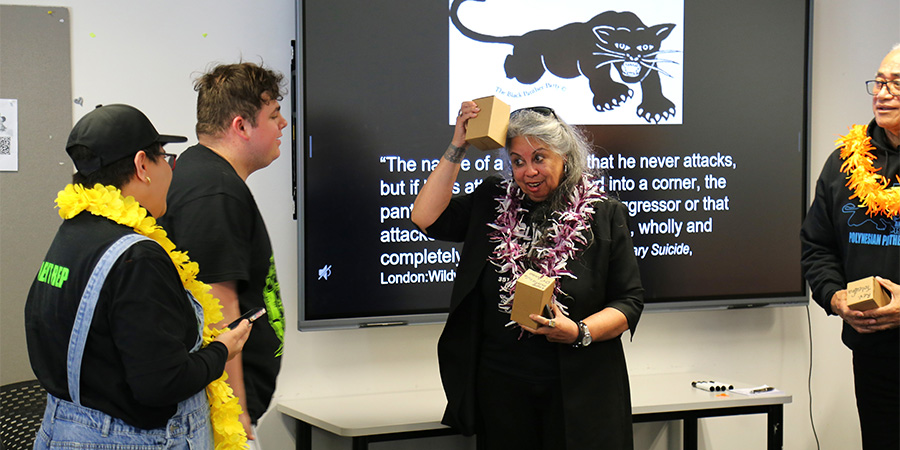
“Educate to Liberate”: Polynesian Panthers bring the struggle for equity to the lecture room for Social Practice students.
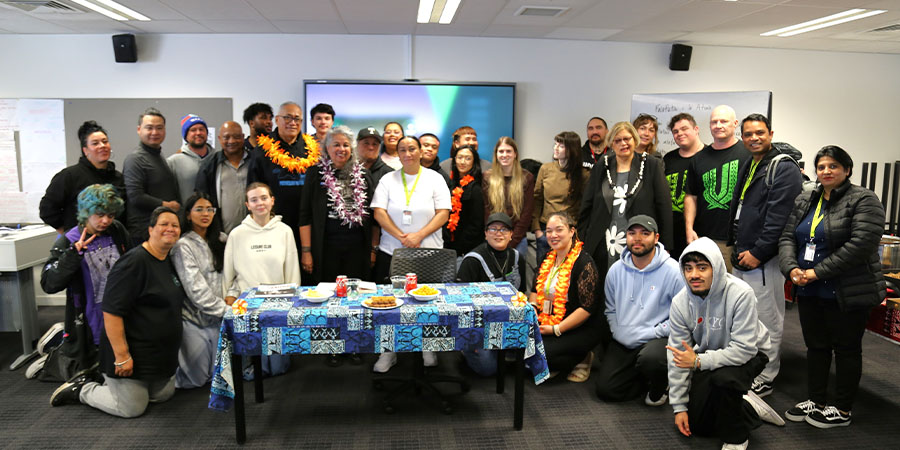
In Brief:
- Polynesian Panthers members Associate Professor Melani Anae and Rev Alec Toleafoa shared firsthand experiences of social activism with future social workers.
- The Bachelor of Social Practice Talanoa Pasifika Course helps ākonga ‘learners’ understand how Aotearoa’s social and political history continues to shape Pacific communities and the issues social workers encounter.
For our ākonga preparing to become social workers and practitioners, learning about social inequality is one thing. Hearing directly from people who fought for it – and who organised their communities to challenge the status quo – is another.
That opportunity came to Waitākere Campus earlier this month when Polynesian Panther Party members Lupematasila Associate Professor Melani Anae and Rev Alec Toleafoa were invited to speak to the Talanoa Pasifika class at School of Social Practice.
The visit gave ākonga an opportunity to connect Aotearoa New Zealand’s history with the realities of the professions they are about to step into: exploring how racism, poverty, identity, community empowerment and institutional systems can affect the people and communities they will work alongside.
The Talanoa Pasifika course, taught by Social Practice Senior Lecturer Sailauama Cheryl Talamaivao, KSM, is a weekly elective for first year Bachelor of Social Practice students. It introduces ākonga to Pasifika approaches to social practice and the development of Pasifika communities in Aotearoa, with a focus on building mutually beneficial relationships and partnerships with Pasifika peoples. The Panthers’ visit brought those principles to life.
Founded in Ponsonby, Auckland in 1971, the Polynesian Panther Party emerged in response to racism, poor housing, poverty and social inequality experienced by Māori and Pacific communities.
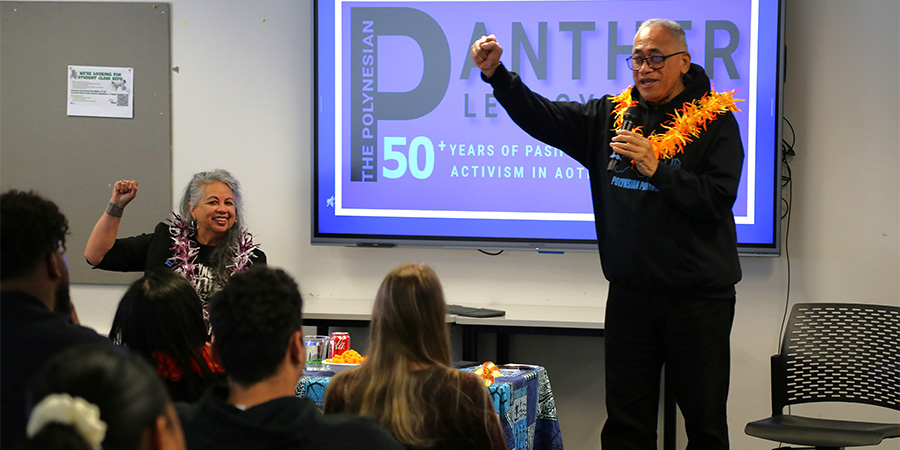
‘Educate to liberate’ is the motto of the Polynesian Panthers and remains a powerful message for future social workers and practitioners, as told by Assoc. Prof Melani Anae (left) and Rev Alec Toleafoa.
The young activists drew inspiration from the Black Panther Party in the United States but developed their own community-focused response in Aotearoa. Their work included education support, advocacy and opposition to the Dawn Raids, when Pacific communities were disproportionately targeted by immigration enforcement.
Their motto, “Educate to Liberate,” remains a powerful message for our future social workers and practitioners.
Rev Toleafoa told ākonga that education and community empowerment were central to the Panthers’ response to their own experiences in the 1970s. They established initiatives such as homework centres for young people, a food co-operative, created a legal aid booklet with the late former Prime Minister David Lange, who was their legal advisor, facilitated prison visits, and campaigned for the rights of Tangata whenua and keeping the Police accountable.
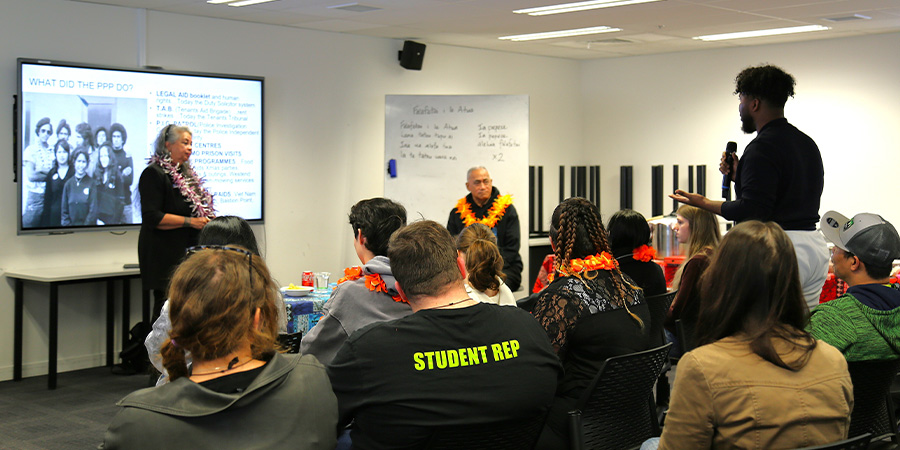
Social Practice students had plenty of questions for the Polynesian Panthers members during the Q&A following their presentation.
“Educate to liberate was our response to our experiences as marginalised communities and living in poverty,” Rev Toleafoa explained.
“Underpinning that is empowering our community to stand in their own mana, use their own voice and speak out against the things that are harming their communities – that is the whole purpose of educate to liberate.”
Rev Toleafoa says the Polynesian Panthers movement demonstrated how a small group of young people could help generate wider social change.
“Because a few teenagers stood up to what was going on in their neighbourhood, we precipitated those changes.”
Assoc. Prof Anae told our ākonga that age should not be a barrier to making a difference. “We were 16- and 17-year-olds when we started the Polynesian Panthers and changed the face of Ponsonby. We stopped the racism and the Police brutality caused by the Dawn Raids, which shows that young people had power. You have power to make change.”
Melani Anae also encouraged students to understand and value their own identities.
“Celebrate your ethnic identity no matter what it is. It defines who you are, so you need to know your history and why racism exists.”
Sailauama Cheryl says the Panthers’ visit is directly connected to the responsibilities ākonga will take into their future careers. The Panthers visit provided an important cultural context for students to explore Pacific identity and the experiences of Pacific communities in Aotearoa.
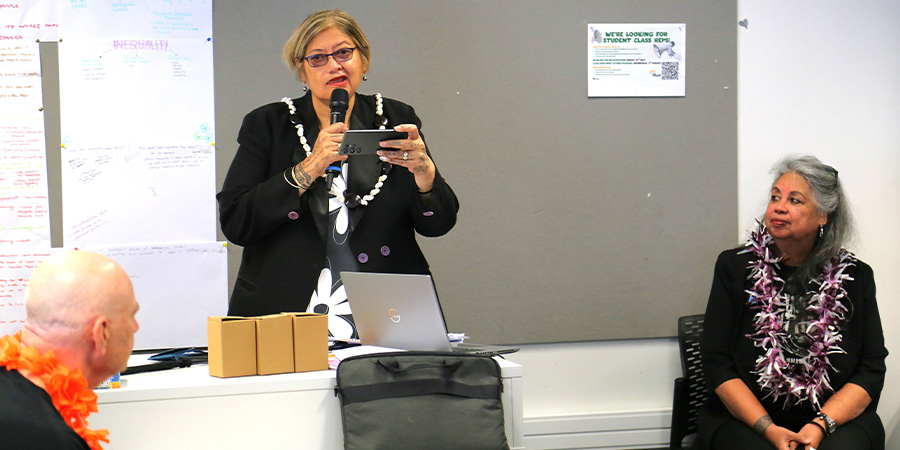
Senior Lecturer Sailauama Cheryl Talamaivao was instrumental in bringing the Polynesian Panthers to her Talanoa Pasifika class through her community relationships.
“This visit was especially significant as our class celebrated Samoa Week, providing a vital anchor for our future social workers to connect systemic history with frontline justice,” Sailauama Cheryl says.
Social work education must equip graduates to understand not only individual circumstances, but the wider systems and histories that impact people’s lives.
“As an institution shaping the next generation of social practitioners, we must confront the uncomfortable truths of Aotearoa’s history.”
The Panthers gave students a firsthand account of the 1970s Dawn Raids and the racial discrimination experienced by Pacific communities and taught our ākonga how to dismantle racism by examining its foundational roots – colonisation, Christianity and capitalism.
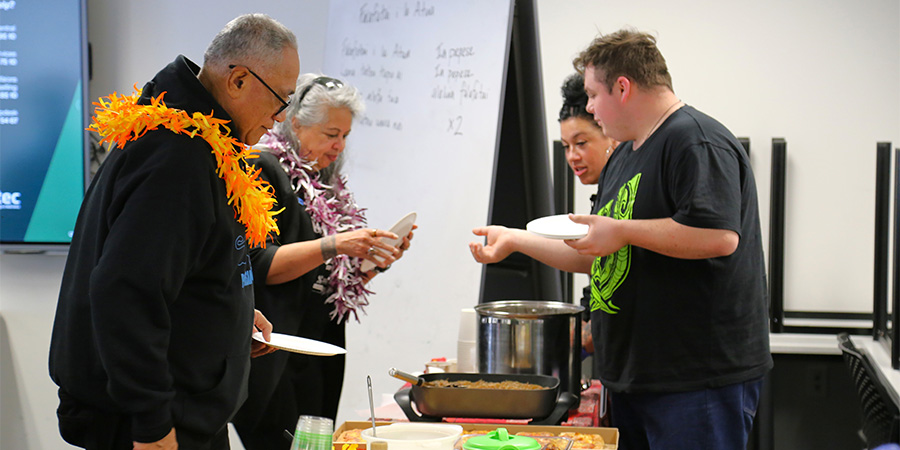
Social Practice students serving kai to our guests from the Polynesian Panthers.
That historical understanding has a direct connection to professional practice.
“For ākonga graduating into social work, understanding this history is not optional.
The effects of historical injustice can continue to be encountered across areas such as healthcare, justice and community housing,” Sailauama adds.
“By learning from the Polynesian Panthers, our ākonga are learning how to move past complacency. They are being equipped to challenge institutional bias, celebrate mana Pasifika, and step into the sector not just as case managers, but as systemic changemakers.”
The Panthers story challenged ākonga to think about their own role in communities and why they have chosen social practice as a career.
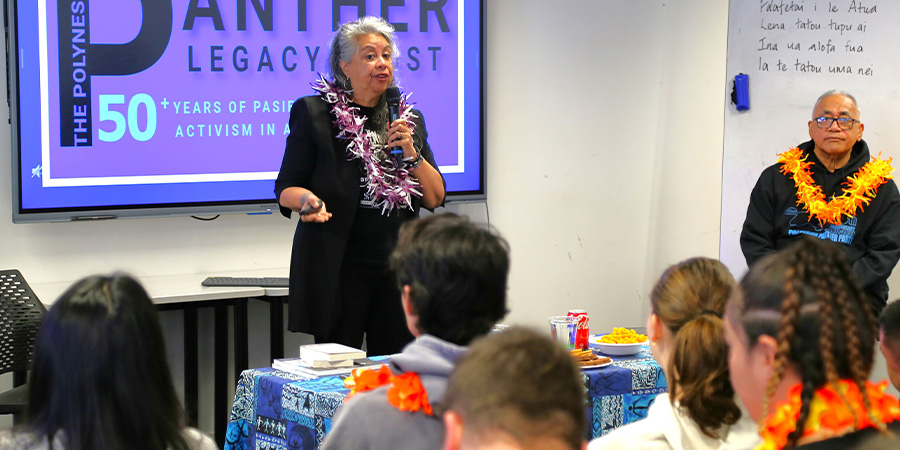
Polynesian Panthers founding member Associate Professor Dr Melani Anae is a senior lecturer in Pacific Studies at the University of Auckland.
Social Practice student Daunte Robinson says the presentation broadened her understanding of protest and community action. She was particularly struck by how the Panthers responded to the Dawn Raids through peaceful protest, education and community support.
“Not all protests from families or communities are going to be loud and violent; they could also be quiet and subtle, and as a social worker, we must be prepared to address both forms of protest,” Daunte says.
Studying social work is also connected to her personal experiences of injustice.
“I choose to study social work because my family and I have experienced the injustice of the internal system and want to become a part of it to change it.”
Fellow student Berta Tofinga says: “What I learned is the importance of advocacy. Hearing about how young they were, made me realise just how important it is to encourage our younger generation to speak up and advocate for their community, culture and themselves.
“Another key learning is that change happens as a collective, not individually, and people need to come together to stand against what is wrong. Social work is all about advocacy and making change. The voices that often don’t get heard need a platform, and this only happens in numbers. Studying social work is an opening for people with different values and cultures to come together to fight for that change
Berta chose this career path to play her part in addressing serious flaws she saw in the system. “When collectiveness and connection in a traditional sense were taken away from us, it created a huge displacement among our people, which has resulted in a lack of community.”
Bachelor of Social Practice student Maiarangi Te Rito Te Waiti says the Polynesian Panthers had already influenced her decision to enter social practice after reading their books and watching their documentaries. After completing a New Zealand Certificate in Health and Wellbeing in 2025, Maiarangi is now continuing her studies with us.
“The Polynesian Panthers were partly the reason why I was inspired to take up study as a solo mother.”
The Panthers’ work continues to influence people more than 50 years after the movement began, including students now preparing to serve their own communities.