AI Hackathon connects students with industry to find real world solutions
In Brief:
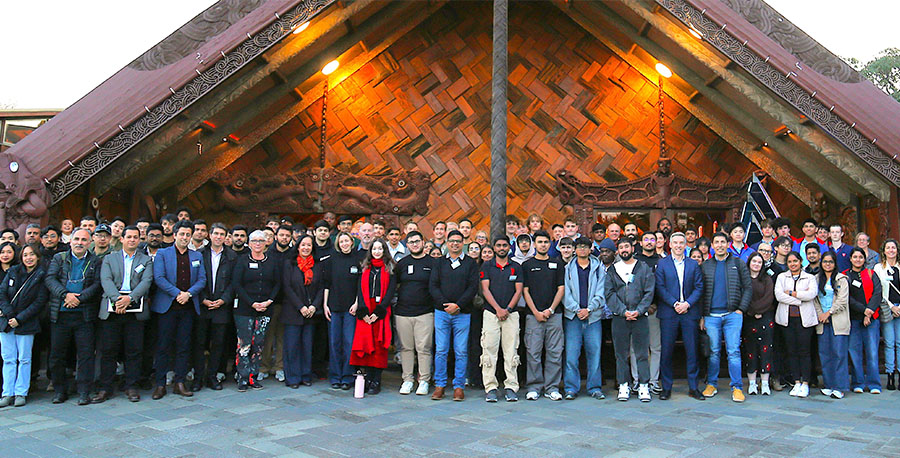
- More than 120 participants and twenty industry mentors came together at Mt Albert Campus for 48 hours of intensive AI innovation, bringing education, technology and industry closer together.
- Seventeen MIT and Unitec ākonga ‘learners’ featured across all four awarded teams, including the winners School Fuel, which will represent Tāmaki Makaurau at the national final in Wellington later this year.
- Teams work together on developing AI-solutions to real world problems under industry and education sector mentorship.
Seventeen of our ākonga ‘learners’ were members of award-winning teams at this year’s 2026 Aotearoa AI Hackathon Auckland regional event held at Mt Albert Campus (6-8 August.)
Overall, there was a strong turnout from MIT and Unitec with around half of the 120 strong field made up of either current or former ākonga.
For 48 hours, ideas were tested, technology was built, and new connections forged as sixteen teams took up the challenge to present solutions to real everyday problems facing our communities using artificial intelligence.
Teams were supported by twenty tech industry mentors who provided guidance, networking opportunities and practical experience.
Event organiser senior lecturer Dr Masoud Shakiba says the hackathon demonstrates exactly why strong connections between education and industry are essential to prepare students for a rapidly changing technology sector.
“Educators need to stay connected with the industry because our students are preparing for an industry that does not stand still.
“This is exactly the kind of environment I believe modern computing education needs.”
Dr Shakiba, who teaches at School of Computing, Electrical & Applied Technology says the value of the event was that it took learning beyond the traditional classroom and placed students in an environment that closely reflects the realities of the workplace.
“Students should not experience education as an isolated journey from the lecture room to assignments and exams, then graduation. The real world doesn’t work that way.
“In the industry, software developers work with business analysts. Data scientists work with domain experts. AI engineers work with product managers. Entrepreneurs work with investors. Designers work with customers.”
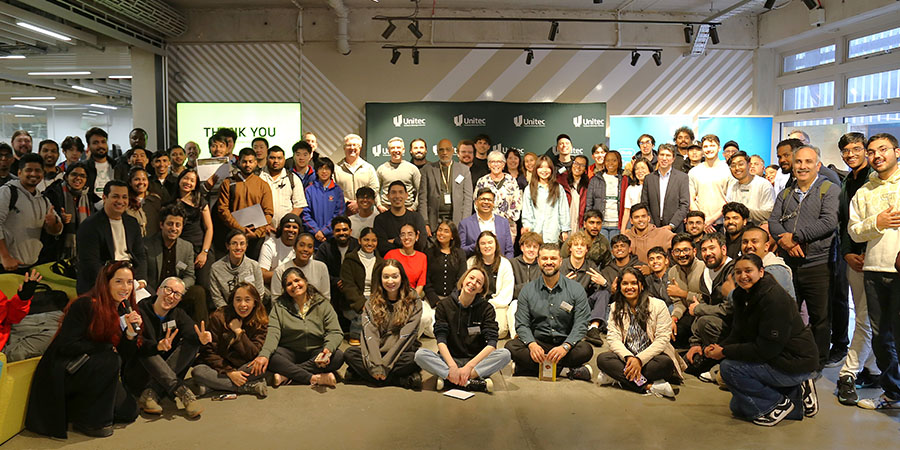
The Aotearoa AI Hackathon brought together undergraduate and postgraduate students, high school learners, professionals, industry and educators to Mt Albert Campus over three days.
Run by AI Forum New Zealand, with support from IoT Forum New Zealand, the event attracted participants from AUT, Otago Polytechnic, New Zealand Skills and Education Group (NZSEG), Eastern Institute of Technology (EIT), Media Design School, Future Skills Academy, Rosmini College, and professionals from organisations including PwC, Westpac New Zealand and Fonterra.
Teams worked intensively through a challenge before presenting their solutions to a judging panel at the Red Lecture Theatre in Te Puna on Saturday.
Among the panellists was MIT and Unitec Associate Professor James Oldfield, alongside Aisha Daji Punga, Ben Dakers and Nilay Rathod.
Student Success
The strength of MIT and Unitec’s student participation was reflected in the results, with fourteen students represented across the four teams recognised in the award categories.
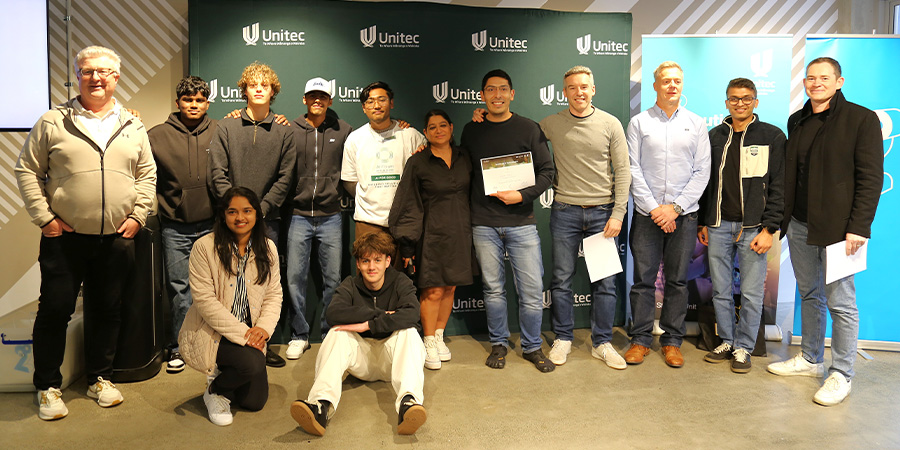
The winning team, School Fuel, including Master of Applied Technologies student Dipesh Shrestha (4th from right back row).
The winning team, School Fuel, which included Master of Applied Technologies student Dipesh Shrestha, brought together student talent with professionals from organisations such as Fonterra and Westpac. They will now represent Tāmaki Makaurau – Auckland at the National Final in Wellington later this year.
For Dr Shakiba, the team was a powerful example of what can happen when people with different experiences and skills work together.
“The composition of this team itself says something important. A Year 13 student can sit alongside experienced professionals and contribute to an AI innovation challenge.
“That is the kind of confidence and capability we want our education system to develop.”
Our students were also represented in Pixie, the Runner Up team, and The Shield, which won the People’s Choice Award.
“Having so many of our students represented across the winning teams was incredibly encouraging,” Dr Shakiba says.
“More importantly, it demonstrated that when students are given authentic problems, access to experienced people, and the freedom to experiment, they can produce work that deserves to be taken seriously.”
Assoc. Prof. Oldfield says a real highlight for him as a judge was seeing how swiftly teams worked to come up with a working prototype of their concept in less than two days.
“They looked good and it was clear that a lot of work had gone into the designs. Teams grappled with real problems that were often personal to them like using AI to offer support those in need or to meet modern challenges, often created by other tech,” explains Assoc. Prof. Oldfield.
“The School Fuel project really stood out to the judging panel. It provided an elegant solution to a real-world problem, using AI to help bring schools in need of funding support together with businesses looking to market themselves in a way that gives back to the community. The quality of the presentation and design of the app was so professional that it was easy to forget it had all been put together through a two-day hack.”
For Dipesh Shrestha (right), who is studying Master of Applied Technologies and joined the winning School Fuel team as a developer, the hackathon provided an opportunity to put his skills into practice while connecting with New Zealand’s technology industry.
Having arrived in the country from Nepal only a month before the event, the experience was particularly significant.
“I’m very happy and feel lucky to be part of the winning team with a wonderful initiative. Everyone in the team was actively participating in their role in making this idea a reality.
“I think this was an excellent opportunity for me to connect with New Zealand’s IT industry and be part of something that can change the community while learning new things and improving myself – it was a wonderful experience.”
The School Fuel team developed an AI-powered solution aimed at helping schools and businesses connect around funding and support.
The idea also resonated personally with Dipesh, who says the challenge related to his experiences growing up in Nepal.
“I resonated with our team concept because where I am from there is no PTA or PTFA where students and school departments can reach out for funding.
“So, everything that needed funding was from the pocket of parents, which can be a financial burden.”
Prabhsimran Singh completed Master of Applied Technologies in June and was part of the Runner Up team Pixie.
“The highlight for me was turning an idea with real social impact into a working solution, while also learning directly from industry leaders and their feedback.”
Pixie developed an app-based solution designed to support the safety, independence and mental wellbeing of older adults. The concept incorporated sensor-based emergency support alongside interactive cognitive games designed to support memory, attention, focus and problem-solving.
Prabhsimran says the intensive experience provided lessons that went well beyond technology.
“The experience taught me a lot about teamwork, rapid problem-solving and refining ideas.”
Building connections beyond the hackathon
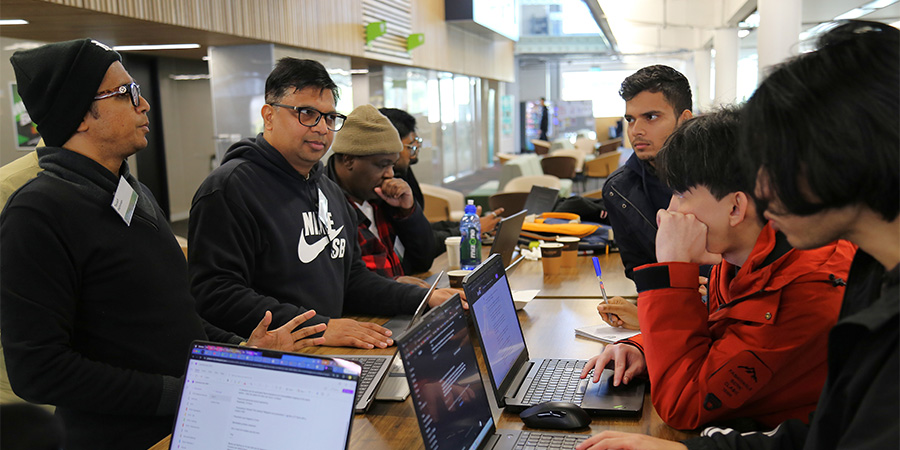
For MIT and Unitec, the value of hosting a regional leg of this national event extends beyond the competition itself. It created opportunities for ākonga to meet potential employers, mentors and collaborators, while giving industry an opportunity to work directly with emerging talent.
Chief Executive Professor Christina Hong says those connections are critical to building an innovation-focused future for Aotearoa New Zealand.
Welcoming participants at Te Noho Kotahitanga Marae on Thursday, Professor Hong acknowledged the contribution of the event’s strategic partner Seen Ventures, sponsors: The School of Computing, Electrical and Applied Technology, 2degrees, Amazon Web Services (AWS), Databricks and Bridgewest Ventures NZ; industry mentors and executive committee members.
“The ideas, innovation and the co-creation that takes place over 48 hours is so important for the innovation agenda, not only this community, but our society and the economy in Aotearoa New Zealand,” Prof Hong says.
“We need those bright sparks of push through and innovation to support this country moving forward.”
Dr Shakiba says the event revealed a strong appetite across education, industry and the wider innovation ecosystem to work together.
“Students want authentic challenges. Industry wants access to emerging talent and innovation. Educators want to ensure our curriculum remains relevant. Startups want people who can build. Investors want promising ideas and capable teams.”
“And society needs people who can use AI responsibly to solve meaningful problems.”
The opportunity now is to turn the relationships and ideas generated during the hackathon into longer-term partnerships.
Potential opportunities include student projects, internships, industry-sponsored projects, research collaborations, start-up incubation and continued industry mentoring.
“The biggest opportunity now is not simply to run another hackathon next year. It is to build on what we have started,” Dr Shakiba remarks.
“Our ambition should be to develop a stronger, longer-term ecosystem connecting students, education, industry, startups, investors, research and innovation. The hackathon can become one component of that ecosystem.”
For the kaimahi ‘staff’ who helped bring the event to life, the event’s success also demonstrated the value of creating opportunities where learning, innovation and industry can overlap.
Dr Shakiba believes that is where the future of tertiary education lies.
“The future of education is not about choosing between academia and industry. It is about bringing the two together to create better learning, better research, better innovation and better outcomes for students and society.”
The success of this year’s event providing the foundations for much longer-term partnerships across education, technology, research and industry.
Aotearoa AI Hackathon – 2026 Auckland Regional Results:
Winner: School Fuel
Concept: “AI-matched funding and support for every New Zealand school”
Team Members:
- Felipe Rojas – Global Strategic Procurement Cat Manager, Ingredients and Innovation Lead at Fonterra
- Ramon Zamorano – Senior Analytics and Insights Specialist at Westpac
- Dipesh Shrestha – Master of Applied Technologies, MIT and Unitec
- Rosmini College Year 13 Students: Mason Beecher, Laine Dominey, Jack Lamont, Risandu Salman, Yanula Silva, Janek Wakuluk
Industry Mentor 1: Anisha Punnoose – AI/IPA Manager at 2degrees
Industry Mentor 2: Michael Murphy – Establishment Board Member at KiwiSaaS Community and Judge at NZ Hi-Tech Awards
Runner up: Pixie
Concept: “Care for your loved ones without the need for surveillance and receive insights into their cognitive health”
Team Members:
- Tarun Joseph Suresh — Master of Applied Technology, MIT and Unitec, Developer at PixelPulse Limited
- Kenneth Stephen — Founder – PixelPulse Limited, Senior Software Engineer at FoodStuffs North Island Limited
- Geffrey Johnson —Master of Applied Technology, MIT and Unitec
- Prabhsimran Singh — Master of Applied Technology, MIT and Unitec
Industry Mentor: Dafydd (Daf) Jones – Founder & CEO of Flamingo
Second Runner Up: Kindred
Concept: “Translating critical documents into sign language and plain language”
Team Members:
Pitching & Presentation:
- Reign Beato,
- Khai Luan Pham,
- Reggie R.,
- Kahvya,
- Herman
Development:
- Daasha Fernando,
- Sujal Gajera,
- Ayush Subedi,
- Dinusha Gammanpila,
- Fereshteh Jaberi
Testing & Quality:
Ayush Subedi,
- Yax Avaiya
UI/UX Design:
- Amani Sadique
Industry Mentor: Thiagu Anandakrishna, Head of Technology, Woolworths NZ
People’s Choice: The Shield
Concept: “Everyone’s racing to deploy AI; we make it safe to trust it, for every business and organisation”
Team Members:
- Akash Pethiya – Master of Applied Technology, MIT and Unitec
- Rajat – Master of Applied Technology, MIT and Unitec
- Sahil Ghodke – Master of Applied Technology, MIT and Unitec
- Viren Bodar – Master of Applied Technology, MIT and Unitec
- Fabio Correia – Diploma in Cybersecurity, MIT and Unitec
- Jennifer Okeh – Master of Applied Technology, MIT and Unitec
- Sathwik Narra – Master of Applied Technology, MIT and Unitec
- Julian Alexander – Bachelor of Computing Systems, MIT and Unitec
- Shotaro Kuroda – Bachelor of Applied Technology, MIT and Unitec
- Didier Michel B. – Cybersecurity Graduate. Aspiring AI-Engineer
- Tausif Rahman – Master of Applied Technology, MIT and Unitec
Industry Mentor: Mohammed Hassanien, IoT/AIoT Product Management at Spark and Executive Board member of IoT Forum NZ


