Researcher sparks national conversation on cat ownership and protecting our wildlife
In Brief:
- Lecturer Chloe McMenamin has prompted a nationwide conversation among the veterinary, conservation and wider communities and gained media attention for her research on cat predation on wildlife.
- Her study found almost 20% of all bird admissions resulted from cat predation which was significantly higher than the rates in the UK, USA, Canada and Australia.
- Cats were responsible for approximately 93.6% of all recorded predation events.
- Research helping understand how good pet ownership can protect biodiversity
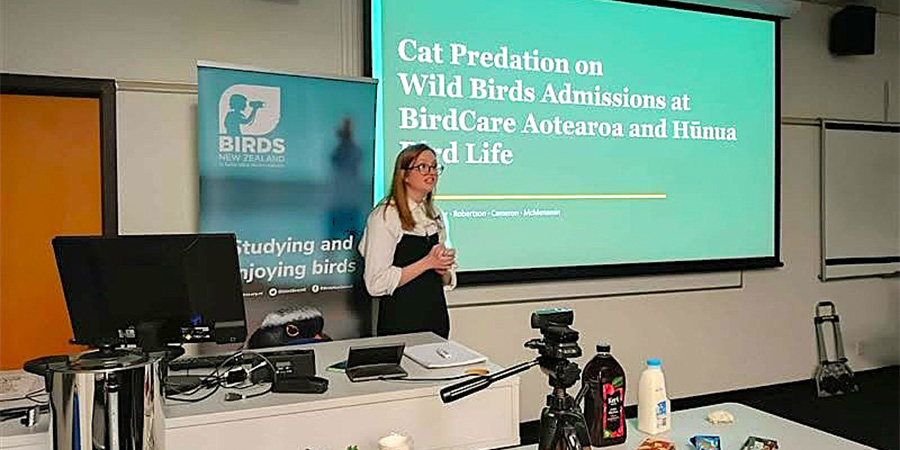
Applied Animal Health lecturer and researcher Chloe McMenamin is gaining national media attention for her research on cat predation on wildlife.
The topic sparked widespread debate on how to protect the country’s unique birdlife while supporting responsible cat ownership.
Chloe was invited by Birds New Zealand to talk about her research last month.
It allowed her to explain how best practice pet ownership could help reduce the impact of cat predation on indigenous and introduced bird populations.
“This was a student led project that is now receiving national attention, which is fantastic,” Ms McMenamin says, acknowledging her research team.
More than 40,000 bird admissions representing 134 species were analysed through data collected from two Auckland-based Wildlife Rehabilitation Centres from 2018-2025.
Almost 20% of all admissions resulted from cat predation which was significantly higher than the rates in the UK, USA, Canada and Australia.
Predation was the third leading cause of admissions (behind injury and orphaned) with cats responsible for approximately 93.6% of all recorded predation events.
The mortality rate from predation was 78.5% higher than any other admission cause.
Passeriformes (or perching birds) which reside in habitats where cats are most common were the most affected bird species at 74.8%. Silvereye/Tauhou was the leading native bird species admitted due to cat predation.
The data categorised and analysed to identify the main trends.
“It was great because the data had to tell the story. We didn’t go into the project with a hypothesis; we simply let the story emerge from the data.”
Among the key findings was that cat attacks were often deadly as bacteria in cat saliva is highly toxic to birds. Any bird that ends up in a cat’s mouth should receive veterinary attention.
The research also found predation places a significant financial and workload burden on wildlife rehabilitators every year. But it’s an actionable issue where cat owners can contribute to reducing this impact.
“The data represents a snapshot of what is happening in the community,” adds Ms McMenamin.
“These are the patients that make it to rescue centres — many people don’t know wildlife rescue services exist, and cats only bring home around one in four of the animals they catch. The results need to be interpreted with that context in mind.”
Her research has attracted growing interest from the veterinary, conservation and wider community because while tackling complex environmental challenges with practical, evidence-based solutions.
The widespread public interest reflecting New Zealanders’ deep commitment to both their native wildlife and their pets.
“New Zealanders are practical, smart people with a strong sense of kaitiakitanga (guardianship) over our native species, but they also have a deeply personal relationship with cats.
“This research sits at a collision point: something people love, and something people are fiercely protective of. It’s not ‘cats are bad’ – it’s ‘here’s what the data actually shows, now what do we do about it?'”
For Chloe, whose career spans veterinary clinical practice, wildlife care and higher education, research is most valuable when it informs real-world decisions.
That philosophy also shapes her teaching. Since joining us in 2022, Chloe has taught across several programmes in School of Environmental and Animal Sciences, helping prepare the next generation of veterinary professionals.
“I do it because I see species disappearing in front of me.
“I’m so worried about the world my niece, nephews and niblings are inheriting, and my work gives me some agency over that feeling.”
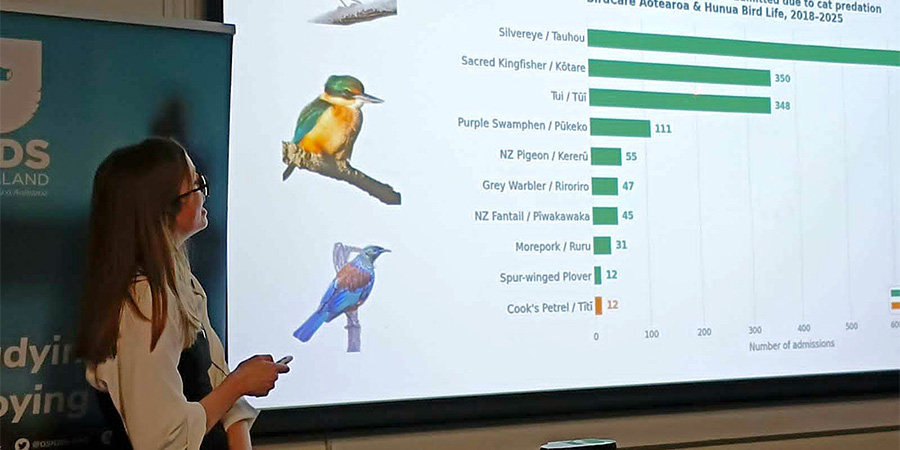
Chloe McMenamin breaks down her research findings on native bird species most impacted by cat predation.
Growing up in Ireland, Chloe developed a fascination with wildlife through hours spent watching Sir David Attenborough documentaries and exploring nearby forests with her father. Seeing large sections of those forests later cleared for logging left a lasting impression.
“I knew I wanted to do something that could help, even in a small way. That’s why I chose veterinary,” says Chloe.
As the debate around cats and native birds continues, Ms McMenamin believes lasting progress depends on collaboration rather than division.
“Data doesn’t ask anyone to feel guilty,” she says.
“It asks everyone – cat owners, conservationists, councils and policymakers – to look at the same set of facts and figure out, together, what a reasonable response looks like.”
Cat owners can help protect both their pets and local wildlife by:
Ensuring their cats are microchipped and desexed
Keeping them indoors where possible
Providing a secure outdoor space such as a catio
Enriching activities, including regular play sessions and foraging toys, can also help keep cats mentally stimulated and content at home.
Department of Conservation (DOC) and SPCA has resources available so people can learn more about recommended practices.
Protecting biodiversity is about much more than saving individual species.
“Biodiversity isn’t a nice-to-have – it’s essential to our survival as a species. If we lose our birds, we lose far more than the birds themselves. We lose our forests. We lose the nutrient transfer between sea and land. And we lose the health of our oceans,” Chloe says.
Everyone has a role to play, whether through predator control initiatives, citizen science and report bird populations, beach clean-ups or making more sustainable choices at home such as recycling.
“As individuals, we hold far more power to create change than we often realise,” Chloe McMenamin says.
Research helping to position our organisation at the forefront of applied animal health study that informs public discussion, supports evidence-based policy and demonstrates how vocational education can contribute to addressing some of our nation’s most pressing environmental challenges.