Architecture lecturer’s national portrait award reinforces practice-led teaching
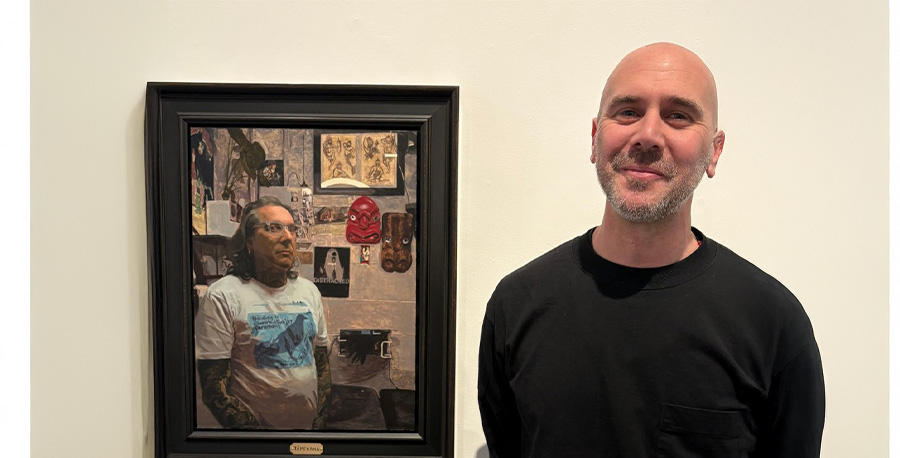
After six appearances as a finalist and years of refining his craft outside traditional pathways, drawing lecturer Duncan Pepe Long has claimed one of New Zealand’s most prestigious portrait awards.
The 48-year-old artist and printmaker won the 2026 Adam Portraiture Award for his portrait Solomon Tāmehana, an oil painting on wood depicting his close friend, artist and tattooist Solomon Tāmehana.
The winning work announced in Wellington on 20 May 2026, was selected from more than 429 entries nationwide and earned Long the $30,000 top prize.
The achievement marks a major milestone for the lecturer from the School of Architecture, who has previously been a finalist for this award five times previously, receiving a highly commended award in 2020.
“Winning was another level of excitement for me,” says Long. “Professionally I think this demonstrates I’m always progressing and growing in my practice.”
Long received the news moments before stepping into a class of 50 students which gave him little time to process the win.
Judge Jude Rae praised the subtlety and emotional depth of the work.
“Duncan’s portrait of Solomon Tāmehana brings acute insight and a remarkably light touch to classical realism,” she remarked.
“In the best tradition of painting, less is definitely more.”
The portrait captures Tāmehana with what Rae described as a “mischievous side eye and informal stance,” reflecting the close friendship between artist and subject.
“This goes back to having an intimate knowledge of the subject,” says Long.
“Solomon is one of my closest friends and they were the first person I thought of when deciding on a subject for the Adam awards entry.”
While Long is now an award-winning portrait artist, his pathway into the arts industry was unconventional. A self-described late starter in painting and printmaking, he spent his twenties as a musician before shifting direction in his early thirties.
“I’ve learned primarily through mentorship rather than formal institutional training, so ‘self-taught’ has never felt entirely accurate to me,” he says.
“That experience has probably made me more open to different ways of learning and developing creatively.”
Long credits printmaker and former kaimahi ‘staff’ John Pusateri and his time assisting at Aotearoa Print Studio as formative influences that solidified his commitment to becoming an artist.
That philosophy now shapes his teaching approach. Since beginning part-time teaching at Unitec in 2012 and becoming a tenured staff member in 2017, Long has taught architectural representation, landscape graphics, life drawing, and printmaking, bringing active industry experience directly into the classroom.
“I consistently maintain my own practice drawing and painting from life,” he says.
“Students benefit directly from seeing their lecturer actively demonstrate a drawing in front of them in real time.”
For Long, the most rewarding part of teaching is helping students realise creative skill is something that can be developed.
“Seeing the students’ confidence grow is so rewarding and being able to show them that it really is possible to learn to draw well,” he says.
“Even if someone feels like they never had that talent, we can show them that all it takes is some knowledge and a lot of practice.”
Long believes maintaining an active professional practice is essential for educators in creative disciplines.
“It’s vital to keep striving for excellence in my practice and I think this directly feeds back into the quality of teaching I can provide for my students.”
Founded in 2000, the Adam Portraiture Award is the country’s premier portrait competition, with all winning works entering the permanent collection of the New Zealand Portrait Gallery Te Pūkenga Whakaata.
The 2026 exhibition runs from 21 May to 9 August at the gallery’s waterfront home in Wellington before touring nationally.
For Long, the award is both recognition and motivation. His next project is already underway — a new solo exhibition of portraits.
“My main inspiration is friends and family,” he says. “I feel the work is a way to celebrate the people I love and care about.”


