Architecture delivers Maui-inspired sculptural marker for major Auckland Infrastructure Project
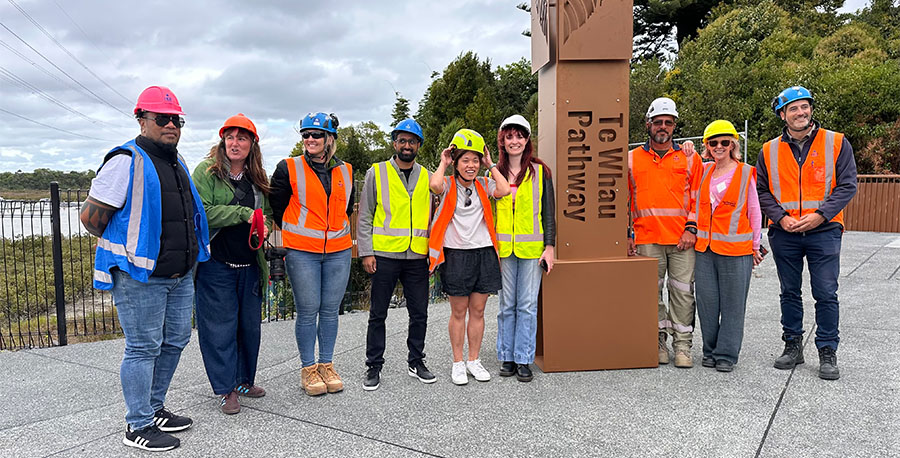
A collaboration between School of Architecture and community organisation Whau The People Charitable Trust has resulted in a new sculptural marker for one of Auckland’s most ambitious civil infrastructure projects.
Mana Fau – Māui’s Cloak, inspired by the mythical Māori navigator Maui, was unveiled on Friday at a ribbon-cutting ceremony in Te Atatū South marking the official opening of the Horowai Connection of the Te Whau Pathway Project. The event drew several hundred residents to Roberts Field, where they explored the newly completed boardwalks and experienced the artwork firsthand.
Te Whau Pathway is a major fifteen kilometre shared walking and cycling coastal route designed to link the city’s two main harbours: Manukau Harbour at Green Bay and Waitematā Harbour at Te Atatū Peninsula. Scheduled for completion later this year, the project represents a significant investment in sustainable transport, recreation, and environmental restoration across Auckland.
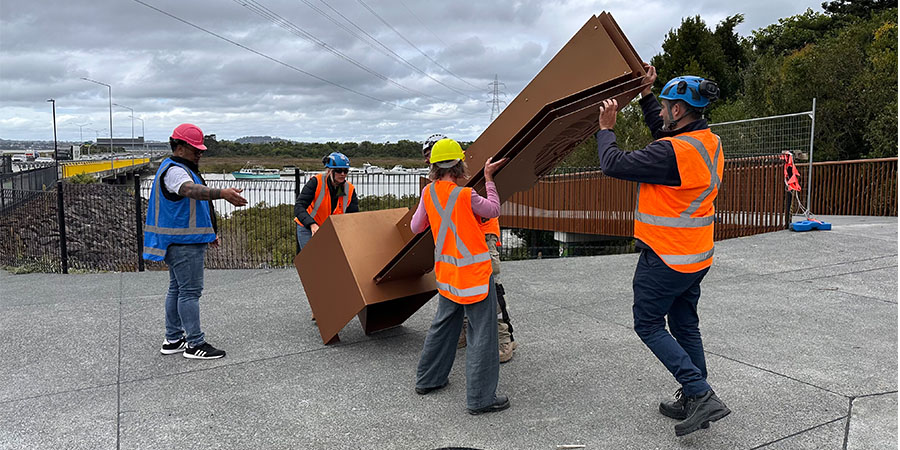
Mana Fau – Māui’s Cloak was designed and built by Architecture students Poppy Finn-House, Cecilia Kuang, and Kyah Suckling, supervised by Academic Programme Manager, Dr Yusef Patel and lecturer, Tavakefai’ana Sēmisi Fetokai Potauaine. Head of School, Professor Peter McPherson and Associate Professor, Dermott McMeel from AUT were also part of the team.
The installation builds on an earlier student-led work, Toutai-ā-Māui: Māui’s Catch, first presented at the Whau Arts Festival in 2023.
Work began in early 2025 last year when the school was commissioned to design and produce a sculpture that would be a signpost for the pathway entrance off the Northwestern Motorway (SH16).
Positioned at a key junction linking Te Whau Awa to the Waitematā Harbour, the sculpture acts as both a physical and symbolic marker. Its form references the cloak of Māui, crafted from woven whau bark, while integrating cultural narratives and environmental elements tied to the local landscape.
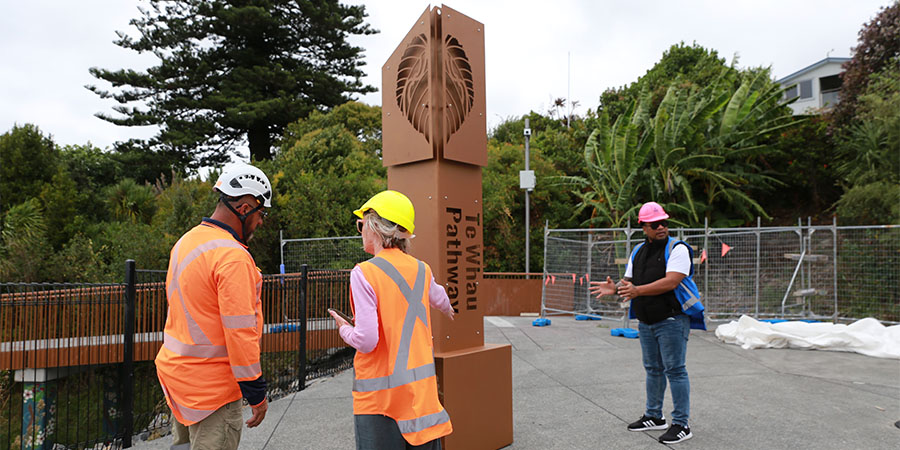
The design incorporates a distinctive whau leaf motif developed by Te Kawerau ā Maki artist Tyler Taua-Gordon, alongside text inspired by Robin Taua-Gordon, etched along the pathway’s handrails. At its base, the branching form of Te Whau Awa is represented, reinforcing themes of connection—between waterways, communities, and histories.
“Mana Fau – Māui’s Cloak was designed taking the work already done by Kyah Suckling, and iterated upon by myself and Cecilia Kuang,” says Ms Finn-House.
“We worked closely with Yusef and Sēmisi throughout the design and build process. It has been very rewarding to see a sketch turn into a sculpture.”
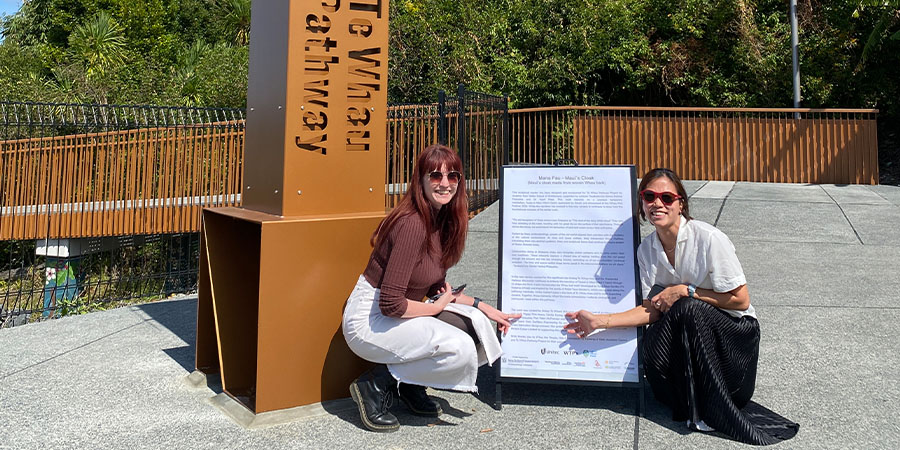
Mr Potauaine described the work as a reflection of continuity and shared perspective.
“These artworks express a shared way of seeing: looking from the old world through the present and into the emerging futures, reminding us of our communities’ continual evolution. The lines and spaces within these forms speak to the interconnectedness we all share,” he explains.
The project highlights the role of applied learning in architecture and design education. Students were involved in every stage, from concept development through to fabrication, supported by industry mentors including Swiftpro Engineering and Perfect Colour Limited.
The initiative demonstrates how collaborative, real-world projects can bridge academic study with professional practice—giving students hands-on experience while contributing meaningful infrastructure to the wider community.
As Te Whau Pathway nears completion, projects like this showcase how vocational education can directly shape public space, culture, and community connection.
Find out info more about the projects:


